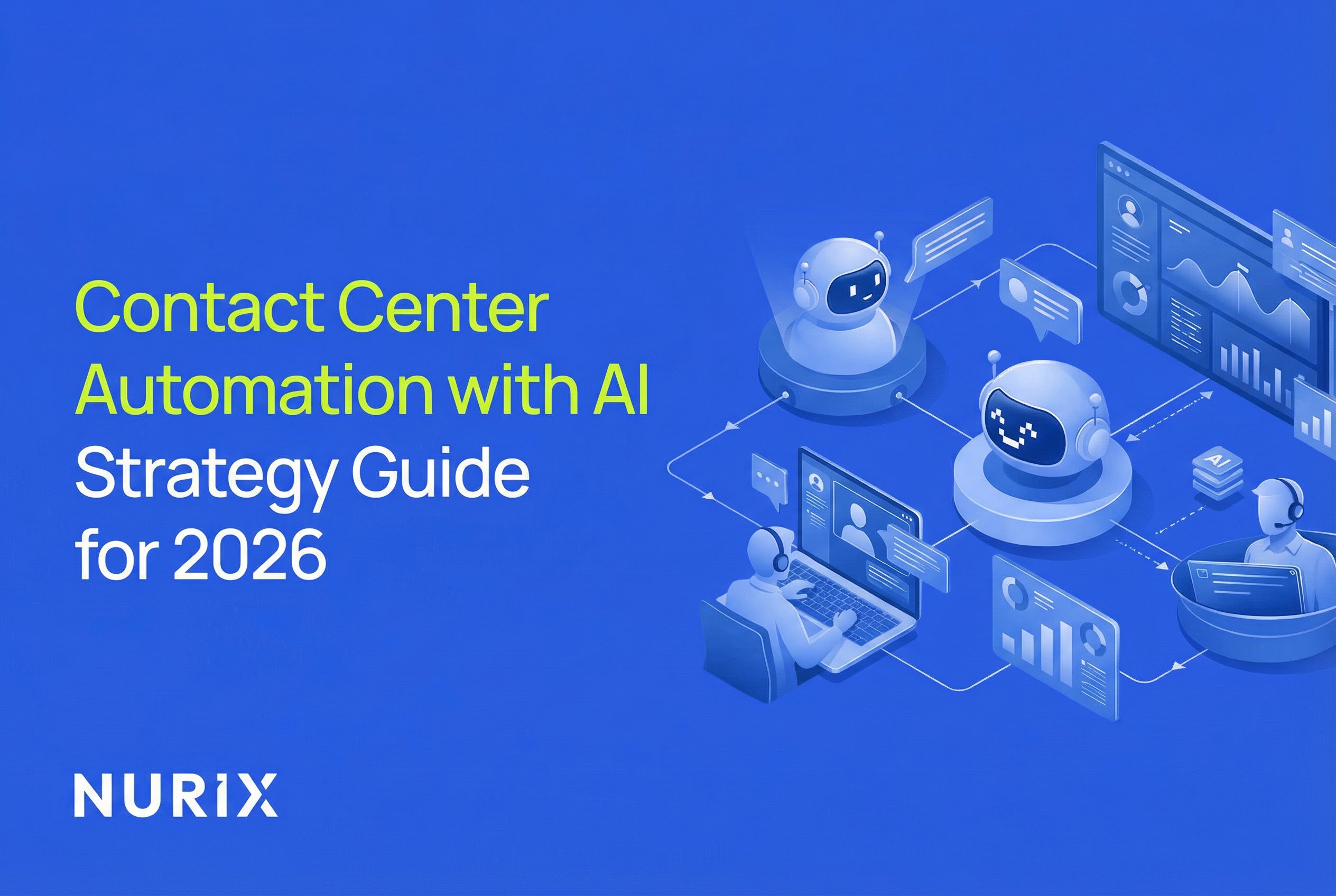

Contact Center Automation with AI: Strategy Guide for 2026
What is Contact Center Automation with AI?
Contact center automation with AI refers to the use of artificial intelligence technologies—such as conversational voice agents, natural language processing (NLP), workflow automation, and AI analytics—to handle customer interactions, assist human agents, and optimize operations across voice, chat, SMS, and email channels.
The modern contact center is under pressure. Agent attrition now reaches 40 to 45 percent annually. Each human-handled interaction costs $6 to $7.
Customers expect instant, personalized support across channels. According to Gartner, conversational AI could reduce global contact center agent labor costs by $80 billion by 2026.
The gap between organizations that embrace contact center automation and those that delay is no longer measured in competitive advantage — it is measured in survival. This guide is built for the CXO, the VP of Customer Service, and the contact center leader who needs a concrete, phased strategy for deploying AI across their operation. We cover the technologies that matter, the implementation sequence that works, the ROI math that earns board-level buy-in, and the pitfalls that derail even well-funded programs.
Quick Verdict: What You Need to Know
If you take nothing else from this article, here are the five points that should shape your 2026 contact center automation strategy:
- Voice AI has matured. Real-time speech recognition, natural-sounding synthesis, and sub-second latency mean AI voice agents can now handle Tier-1 calls end-to-end, not just route them.
- Agentic AI is the next frontier.Gartner predicts that by 2029, agentic AI will autonomously resolve 80 percent of common customer service issues without human intervention, leading to a 30 percent reduction in operational costs.
- The ROI timeline is compressing. Organizations now see positive returns within 8 to 14 months, with cost-per-contact decreasing by 20 to 40 percent.
- Agent augmentation beats agent replacement. The winning strategy is not eliminating humans but elevating them — reducing burnout, accelerating onboarding, and reserving live agents for high-value interactions.
- Orchestration is the differentiator. The platforms that win are those that coordinate AI agents, human agents, analytics, and workflows in a single pane of glass.
The Current State of Contact Centers: A System Under Strain
The global contact center software market is projected to grow from $77.82 billion in 2026 to $263.75 billion by 2034, a trajectory that reflects both the scale of the problem and the size of the investment organizations are making to solve it. But raw market growth masks the operational reality on the ground.
Agent turnover remains the industry's most expensive problem. Average agent tenure has dropped to just 13 to 15 months, and replacing a single departing agent costs between $10,000 and $20,000 when factoring in recruitment, training, and lost productivity.
For a 100-agent center, that translates to over $1 million annually in churn-related costs alone. Over 60 percent of departing agents cite stress as their primary reason for leaving.
Meanwhile, the industry-average handle time sits at 6 minutes and 10 seconds per interaction, and the pressure to reduce it often comes at the expense of resolution quality. Customers are caught in the crossfire: pushed through IVR trees, asked to repeat information, and escalated through multiple agents before reaching someone who can actually help.
The result is a vicious cycle. Overworked agents deliver inconsistent service, which drives customer churn, which increases volume, which burns out agents faster. Contact center automation with AI is the only lever that breaks this cycle at scale.
What Contact Center Automation Actually Means in 2026
Let us be specific about terminology, because the phrase "contact center automation" has been diluted by years of marketing. In 2026, genuine automation means AI systems that can understand intent, execute multi-step workflows, and learn from outcomes — not just keyword-matching chatbots or rigid IVR scripts.
First-generation automation was rule-based. Think: "Press 1 for billing." It reduced call routing time but did nothing to resolve issues or reduce agent load in a meaningful way.
Second-generation automation introduced NLP-powered chatbots that could handle FAQ-style queries. These helped, but they broke down the moment a conversation deviated from a scripted path. If you are evaluating where chatbots end and true AI agents begin, this comparison of AI agent orchestration versus chatbots is worth reading.
Third-generation automation — the category that defines 2026 — is built on large language models, agentic architectures, and real-time voice AI. These systems do not just understand what a customer is saying; they understand what the customer is trying to accomplish, pull data from backend systems, take action, and confirm resolution. They handle ambiguity, manage multi-turn conversations, and critically, know when to escalate to a human.
This is the paradigm shift that NuPlay (previously Nurix) was built for. NuPlay's platform treats AI agents not as standalone bots but as orchestrated participants in a broader service ecosystem, working alongside human agents, analytics engines, and business logic in real time.
The Five Technologies Powering Contact Center Automation
1. Conversational Voice AI
Voice remains the dominant channel for complex and emotionally charged interactions. The breakthrough in 2026 is not that AI can process speech — it is that AI can now do it with human-level naturalness and sub-200-millisecond latency.
Modern voice AI systems deliver three measurable impacts:
- Reduces call volume. AI voice agents handle Tier-1 calls end-to-end — from greeting to resolution — without human intervention, freeing live agents for high-value interactions.
- Improves response speed. Sub-200-millisecond latency, real-time interruption handling, and mid-sentence sentiment detection create conversations that feel natural, not robotic.
- Increases containment rates. Full call-flow management (authentication, data lookup, action execution, confirmation) keeps more interactions within the automated channel.
This is where NuPlay's AI agents come in. NuPlay deploys purpose-built voice agents for contact centers, capable of managing complete call flows without human handoff on Tier-1 queries. NuRep governs the brand representation layer — ensuring every AI interaction sounds, behaves, and responds on-brand, compliant, and aligned with enterprise expectations.
For a deep dive into how AI is transforming the voice channel, the Nex by Nurix Ep 28: Supercharge Call Systems episode walks through real-world deployment patterns and the architecture behind reliable voice automation.
2. Natural Language Processing and Understanding
NLP and NLU have moved well beyond keyword extraction. Today's models parse complex, compound customer requests ("I need to change my address and also dispute the charge from last Tuesday") into discrete intents, resolve them in parallel, and confirm each one. Intent detection accuracy in production systems now exceeds 95 percent for trained domains, which is a threshold that makes full automation viable for high-volume, repetitive query types.
3. Real-Time Agent Assist
Not every interaction should be fully automated. For complex or sensitive calls, agent assist technology provides live agents with real-time transcription, suggested responses, knowledge base surfacing, and compliance prompts. The impact is measurable: McKinsey research documented a 14 percent increase in issue resolution per hour and a 9 percent reduction in handle time when agents were augmented with AI tools. Agent attrition drops by 25 percent with AI coaching, saving roughly $12,000 per retained agent per year.
4. AI-Powered Analytics and Quality Management
Legacy QA sampled maybe 2 to 3 percent of calls. AI-powered conversation intelligence platforms like NuPlay's NuPulse analyze 100 percent of interactions in real time, scoring calls on compliance, sentiment, resolution effectiveness, and customer effort.
This turns quality management from a backward-looking audit into a forward-looking optimization engine. Leaders can identify trending issues before they spike, spot coaching opportunities by agent, and measure the direct impact of process changes on customer outcomes.
5. Orchestration and Workflow Automation
The most underrated technology in the stack is orchestration — the layer that decides which AI agent handles which query, when to escalate to a human, how to route across channels, and how to chain backend actions (refund processing, appointment scheduling, order modification) into seamless workflows. NuPlay's NuPilot serves this exact function, acting as the intelligent orchestration layer that coordinates AI agents, human agents, and enterprise systems in a unified workflow.
Without orchestration, you end up with disconnected point solutions. With it, you get a contact center that operates as a single, intelligent system.
Contact Center AI Technologies Compared
A Phased Implementation Strategy That Actually Works
The biggest mistake in contact center automation is trying to automate everything at once. The second biggest mistake is running a perpetual pilot that never scales. Here is a phased approach that balances speed with risk management.
Phase 1: Foundation (Months 1-3)
Objective: Instrument, baseline, and automate your highest-volume, lowest-complexity interactions.
Start by deploying analytics across 100 percent of your interactions. You cannot optimize what you do not measure.
Identify your top 10 call drivers by volume and classify them by complexity. The bottom third — password resets, order status checks, appointment confirmations — are your Phase 1 automation candidates.
For a practical walkthrough of how to automate your call center with AI, our step-by-step guide covers the technical details of this phase. Deploy a conversational AI agent on these use cases.
Measure containment rate (the percentage of interactions resolved without human handoff), customer satisfaction on automated interactions, and average handle time for calls that do escalate. Your Phase 1 target: 30 to 40 percent containment on Tier-1 queries.
Phase 2: Augmentation (Months 4-8)
Objective: Deploy agent assist for human-handled interactions and expand automation to mid-complexity use cases.
Our guide to real-time AI agent assist for contact centers covers the ROI and deployment patterns for this capability in detail. Roll out real-time agent assist to your live agent workforce. This includes auto-transcription, knowledge base surfacing, next-best-action prompts, and automated after-call work.
Simultaneously, expand your AI agent coverage to mid-complexity queries — billing disputes, plan changes, multi-step troubleshooting — using agentic workflows that can pull and push data from your CRM, billing system, and order management platform.
Your Phase 2 targets: 15 percent reduction in average handle time for human-handled calls, 50 to 60 percent overall containment rate, and measurable improvement in agent satisfaction scores.
Phase 3: Optimization (Months 9-14)
Objective: Close the loop with predictive analytics, proactive outreach, and continuous model improvement.
Deploy predictive models that identify customers likely to call before they do, and trigger proactive outreach via their preferred channel. Use interaction analytics to continuously retrain your AI models on edge cases and failure modes.
Integrate customer journey data to personalize every interaction based on history, sentiment, and predicted need. Your Phase 3 targets: 70 percent or higher containment rate, cost-per-interaction reduction of 40 percent or more versus baseline, and net promoter score improvement of 10 or more points.
The ROI Calculation Framework
Contact center automation ROI is not theoretical. Here is how the numbers shift for a typical 200-agent center.
Before vs After: Contact Center Automation ROI
These numbers align with industry benchmarks. Forrester TEI studies consistently show 250 to 300 percent three-year ROI on contact center AI investments, and organizations report seeing initial benefits within 60 to 90 days of deployment.
The less quantifiable but equally important returns include reduced agent burnout, lower attrition costs, improved compliance rates, and the ability to scale service capacity without proportional headcount increases.
Seven Pitfalls That Derail Contact Center Automation Programs
1. Starting with the technology instead of the problem. Every failed automation program we have seen began with "we need a chatbot" rather than "we need to reduce Tier-1 call volume by 40 percent." Start with the outcome. Let the outcome dictate the technology.
2. Ignoring the agent experience. If your agents view AI as a threat rather than a tool, adoption will stall. The most successful deployments frame AI as the thing that eliminates the tedious parts of the job and lets agents focus on the work that actually requires human judgment and empathy.
3. Underinvesting in integration. An AI agent that cannot access your CRM, billing system, or order management platform is just a fancy FAQ page. Budget for integration work — it typically accounts for 30 to 40 percent of total implementation cost and is the single biggest determinant of containment rate.
4. Optimizing for containment at the expense of experience. A 90 percent containment rate means nothing if customers are frustrated by the automated experience. Always pair containment metrics with CSAT and customer effort scores on automated interactions. If satisfaction drops, you have pushed automation too far.
5. Skipping the analytics layer. Deploying AI agents without comprehensive interaction analytics is like flying without instruments. You need visibility into every conversation — automated and human — to identify failure patterns, optimize routing, and continuously improve model performance.
6. Treating automation as a one-time project. Contact center automation is an operating model, not a project. Customer intents shift, products change, and AI models drift. Plan for ongoing model tuning, quarterly use case expansion, and continuous feedback loops between your AI system and your QA team.
7. Choosing a point solution over a platform. Bolting together a voice bot from one vendor, a chat agent from another, and an analytics tool from a third creates integration overhead, data silos, and inconsistent customer experiences.
Platforms like NuPlay that unify AI agents, brand governance (NuRep), conversation intelligence (NuPulse), and orchestration (NuPilot) eliminate this fragmentation from day one. You can explore the benefits of AI-powered customer service in more detail in this guide to AI chatbots for customer service.
Vendor Evaluation Criteria: What to Look For
When evaluating contact center automation platforms, score vendors across these eight dimensions:
Voice-first capability. Can the platform handle real-time voice interactions with production-grade latency and naturalness, or is voice an afterthought bolted onto a text-first system?
Orchestration depth. Does the platform coordinate AI agents, human agents, and backend systems in unified workflows, or does it require you to build that logic yourself?
Integration ecosystem. What pre-built connectors exist for your CRM, telephony, workforce management, and backend systems? What does the API layer look like for custom integrations?
Analytics coverage. Does the platform analyze 100 percent of interactions across all channels, or does it rely on sampling? Can it score in real time or only post-call?
Agentic architecture. Can the AI agents execute multi-step workflows autonomously (process a refund, update an account, schedule a callback), or are they limited to conversational responses?
Scalability and reliability. What is the platform's track record at enterprise scale? What are the SLA commitments for uptime, latency, and throughput?
Security and compliance. Does the platform support your regulatory requirements (PCI-DSS, HIPAA, GDPR)? How is data handled, stored, and retained?
Total cost of ownership. Look beyond per-seat or per-minute pricing. Factor in integration costs, ongoing tuning requirements, and the internal team needed to operate the platform.
What Comes Next: The 2026-2028 Horizon
By 2028, contact centers will no longer operate as reactive service desks. AI systems will predict issues, initiate proactive support, and resolve many customer journeys autonomously — spanning multiple departments and systems, not just individual interactions.
Three developments will define this shift:
- Proactive service will overtake reactive service as AI gains the ability to predict customer needs and intervene before issues escalate.
- Multimodal interactions will become standard, with AI agents seamlessly moving between voice, text, video, and visual collaboration within a single session.
- Autonomous agentic AI will handle end-to-end customer journeys, from initial contact through resolution and follow-up, without human involvement on routine paths.
Gartner research confirms this trajectory: 91 percent of customer service leaders now face executive pressure to implement AI not just for efficiency but to directly improve customer satisfaction. The organizations that build their automation foundation in 2026 will be the ones positioned to capitalize on these advances as they mature.
Want to see contact center automation in action? Explore how NuPlay AI voice agents automate calls, assist agents in real time, and orchestrate workflows across CRM and support platforms.