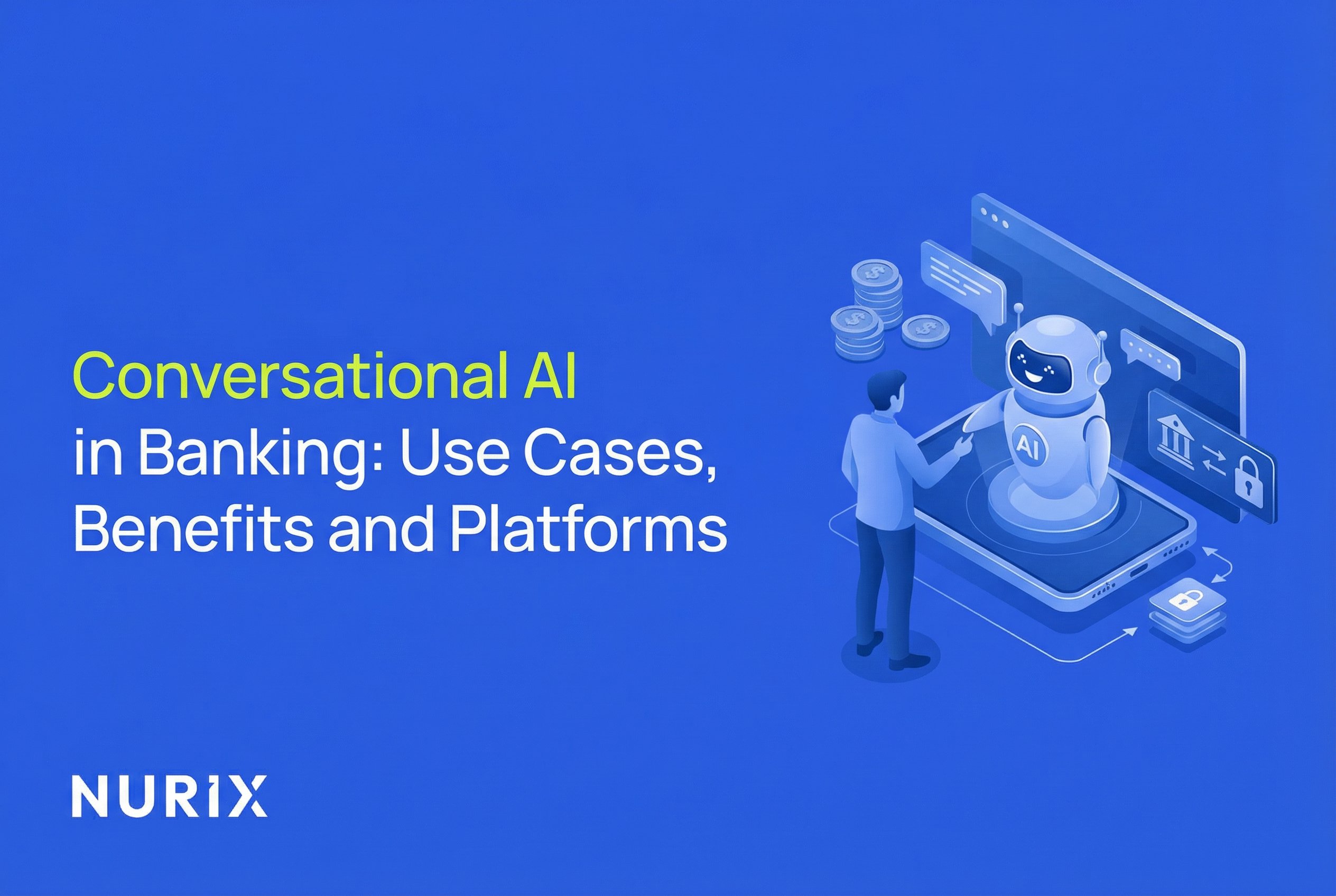

Conversational AI in Banking: Use Cases, Benefits & Platforms
Banking customers no longer tolerate hold queues, clunky IVR menus, or week-long loan approvals. They expect instant, intelligent, round-the-clock service and the institutions that deliver it are pulling ahead fast.
Conversational AI in banking is the technology making that possible, powering voice and chat agents that handle everything from balance inquiries and fraud alerts to end-to-end mortgage applications. With the global AI-in-banking market projected to reach USD 379 billion by 2034 and McKinsey warning that banks slow to adopt AI could see profit pools shrink by 9% globally, the question is no longer whether to deploy conversational AI but how quickly you can get it right.
Conversational AI in banking uses AI-powered voice and chat agents to automate customer service, support lending, strengthen fraud response, streamline onboarding, and improve 24/7 banking experiences. Banks adopt it to reduce service costs, speed up resolution times, improve compliance, and scale customer interactions across channels.
NuPlay (previously Nurix) is an enterprise AI platform purpose-built for deploying conversational voice and chat agents at scale across banking, insurance, and financial services. While we have covered the broader landscape of conversational AI trends in finance and banking and explored banking chatbot use cases in previous guides, this article takes a different approach: a 2026-specific platform comparison and ROI-focused use case breakdown designed to help decision-makers evaluate concrete options and quantify returns. We break down the most impactful use cases, quantify the benefits with current data, walk through implementation considerations, and compare the leading platforms so you can make an informed decision for your institution.
Quick Verdict: Banks deploying conversational AI are seeing measurable results:
- 20–50% reduction in service costs
- 3–5x faster loan processing
- Higher customer satisfaction scores
The technology has moved well past the experimental phase. According to Gartner, agentic AI will autonomously resolve 80% of common customer service issues without human intervention by 2029. If your institution is still relying on rule-based chatbots or outsourced call centers, you are already behind.
Why Conversational AI Has Become a Banking Imperative
The pressure is coming from every direction. Customers have been trained by consumer apps to expect instant, personalized responses.
Fintechs are capturing market share with frictionless digital experiences. Regulators are raising the bar on compliance and data governance. And margins are tightening across retail and commercial banking alike.
McKinsey's research reveals that fintechs account for nearly 70% of AI-focused product launches despite making up only 40% of the financial services landscape. Their advantage comes from fewer legacy constraints and a willingness to move fast. Traditional banks that fail to close this gap risk losing not just customers but entire product categories.
Meanwhile, Accenture's Banking Consumer Study found that 65% of consumers are open to using a GPT-like financial assistant, and 71% would welcome an AI assistant within their primary bank's mobile app. The appetite is there. What most institutions lack is the infrastructure and orchestration layer to deliver these experiences safely, at scale, and within regulatory guardrails.
This is precisely where platforms like NuPlay come in, providing the agent orchestration framework that lets banks move beyond basic chatbots into truly autonomous, multi-turn conversational agents. For a foundational overview of how conversational AI enhances banking services, see our detailed guide.
Top Use Cases for Conversational AI in Banking
1. Intelligent Customer Service and Support
The most immediate and widely adopted use case is customer service automation. AI-powered voice and chat agents can handle account inquiries, transaction disputes, card activations, password resets, and dozens of other routine requests without human involvement. Gartner reports that 85% of customer service leaders explored or piloted conversational GenAI solutions in 2025.
What separates modern conversational AI from legacy chatbots is contextual understanding. Rather than matching keywords to scripted responses, platforms like NuPlay deploy AI agents that interpret intent across complex multi-turn conversations, access customer data in real time, and resolve issues end-to-end — with NuRep ensuring every interaction maintains brand voice and compliance standards. For a deeper look at how this differs from traditional approaches, see AI Chatbots in Customer Service: Beyond the Basics.
The financial impact is substantial. Deloitte's research shows that companies using generative AI are 35% less likely to report that human agents feel overwhelmed by information during calls, directly improving both agent retention and customer experience.
2. Lending and Loan Origination
Loan processing is one of the most transformation-ready areas in banking. Conversational AI eliminates the bottlenecks of manual review by automating underwriting, cross-referencing documents, and verifying applicant data in real time. What once took days or weeks can now happen in minutes.
Applying for a mortgage or personal loan is often intimidating for customers. Long forms, confusing terminology, and multi-step verification create friction that leads to high abandonment rates. A conversational AI agent acts as a personal guide, walking applicants through each step, answering questions like "What does my debt-to-income ratio need to be?" with simple, easy-to-understand explanations, and collecting documentation through guided conversational prompts.
This is exactly the challenge explored in Episode 38 of the Nex by Nurix series, "Fast Execution in Lending". The episode breaks down how AI agents compress the lending cycle, reduce manual touchpoints, and give operations teams real-time visibility into pipeline health, all critical capabilities for banks looking to compete with fintech lenders on speed and experience.
AI in Loan Servicing: How Indian Banks Are Leading
India's banking sector has become a global proving ground for AI-powered loan servicing. Major institutions including HDFC Bank, ICICI Bank, and State Bank of India have deployed conversational AI across the lending lifecycle, from pre-qualification and document collection to disbursement tracking and EMI management.
HDFC Bank's EVA (Electronic Virtual Assistant) handles millions of customer queries monthly, including loan status checks, EMI calculations, and pre-approved loan offers delivered through conversational prompts. ICICI Bank uses AI agents for instant personal loan approvals, reducing processing time from days to minutes for pre-qualified customers. State Bank of India's YONO platform integrates conversational AI to guide customers through home loan applications, auto-populating forms from Aadhaar and PAN data.
The pattern across Indian banks is consistent: AI agents handle the high-volume, repetitive aspects of loan servicing (balance inquiries, payment reminders, document follow-ups) while routing complex cases like restructuring requests or disputes to human loan officers with full conversation context. For institutions processing millions of loan interactions monthly, this hybrid model delivers 30-40% cost reduction in servicing operations while improving customer response times from hours to seconds.
Platforms like NuPlay are purpose-built for this scale, providing the orchestration layer that connects AI agents to core banking systems, loan origination platforms, and regulatory compliance engines, which is critical infrastructure for Indian banks operating under RBI guidelines.
3. Fraud Detection and Real-Time Alerts
Fraud remains one of the costliest challenges in banking. Conversational AI adds a critical layer of defense by engaging customers the moment suspicious activity is detected. Rather than sending a generic SMS that often goes ignored, an AI agent can call or message the customer, walk them through the flagged transactions, and instantly freeze or release the card based on confirmed responses.
Capital One's chatbot "Eno" is a well-known example: it analyzes spending patterns, sends real-time fraud alerts, and handles complex follow-up questions with a human-like conversational tone. NuPlay's platform takes this further with NuPulse, its conversation intelligence engine that captures sentiment detection, intent recognition, and conversation quality signals across channels — flagging anomalies for both fraud prevention and compliance teams.
4. Customer Onboarding and KYC
Lengthy sign-up forms are one of the primary reasons potential customers abandon the account opening process. Conversational AI transforms onboarding into a guided, interactive experience. The agent collects information one piece at a time through guided conversational prompts, prompts document uploads directly within the chat, and triggers backend verification workflows automatically.
By connecting to identity verification APIs, credit bureaus, and internal systems, the AI agent can complete KYC checks in a single session. This drastically improves completion rates and gives new customers a strong first impression of the institution's digital maturity.
5. Wealth Management and Financial Guidance
Conversational AI is increasingly being deployed for personalized financial guidance. AI agents can analyze a customer's spending patterns, savings behavior, and investment portfolio to offer tailored recommendations. This is not about replacing human financial advisors but about extending advisory-quality engagement to the 80-90% of customers who would never schedule a meeting with a wealth manager.
Banks using conversational AI for proactive outreach, such as alerting customers to savings opportunities, upcoming bill spikes, or investment rebalancing triggers, are seeing higher engagement rates and deeper product penetration.
6. Collections and Payment Reminders
Collections is a sensitive area where conversational AI delivers outsized value. AI voice agents can handle early-stage payment reminders with empathy and consistency, offering flexible repayment options and processing payments within the same conversation. This replaces aggressive call-center tactics with a measured, compliant approach that improves recovery rates while protecting the customer relationship.
Banking Use Cases: Impact vs Implementation Complexity
Key Benefits of Conversational AI for Banks
Dramatic Cost Reduction
McKinsey estimates that AI adoption will trim banking industry costs by up to 20%. Accenture's banking operations practice cites potential cost efficiency improvements of up to 50% when AI and data are leveraged strategically across operations. These are not theoretical projections. Banks that have deployed conversational AI at scale are already reporting 30-40% reductions in contact center costs within the first 12-18 months.
Faster Resolution and Processing Times
Conversational AI compresses timelines across the board. Customer service queries that previously required 8-12 minutes of agent time can be resolved in under 2 minutes. Loan applications that took 5-7 business days to process can reach conditional approval in hours.
Account openings that required branch visits can be completed in a single mobile session. Speed is no longer a differentiator; it is a baseline expectation.
24/7 Availability Without Staffing Costs
Unlike human agents, AI agents do not have shifts, holidays, or sick days. A single deployment can handle thousands of concurrent conversations across voice, chat, and messaging channels. For banks operating across time zones or serving international customers, this eliminates the need for follow-the-sun staffing models while maintaining consistent service quality.
Improved Compliance and Auditability
Every AI conversation is logged, timestamped, and searchable. This creates a complete audit trail that compliance teams can review, search, and analyze at scale. Conversational AI can also be programmed to enforce regulatory disclosures, consent collection, and identity verification steps, reducing the risk of human error in compliance-critical interactions.
Scalability During Peak Demand
Tax season, stimulus disbursements, market volatility events, and product launches all create demand spikes that overwhelm traditional contact centers. Conversational AI scales instantly to meet surges without degradation in response quality or wait times.
What to Look for in a Conversational AI Platform for Banking
Not all platforms are built for the demands of financial services. Here are the capabilities that matter most when evaluating a conversational AI solution for banking.
Enterprise-Grade Security and Compliance. Banking conversations involve sensitive PII, account data, and financial transactions. The platform must support end-to-end encryption, role-based access controls, SOC 2 compliance, and data residency options. Regulatory alignment with frameworks like GDPR, PCI-DSS, and local banking regulations is non-negotiable.
Omnichannel Orchestration. Customers interact through voice calls, mobile apps, web chat, WhatsApp, and more. The platform should maintain conversation context seamlessly across channels so a customer who starts on chat and escalates to voice does not have to repeat themselves. NuPlay's NuPilot orchestration engine was designed specifically for this challenge, routing conversations across channels and agents while maintaining full context.
Integration with Core Banking Systems. The conversational AI platform must connect to your core banking system, CRM, loan origination platform, fraud detection engines, and KYC providers. Without deep integration, the AI agent becomes a glorified FAQ bot that cannot actually resolve issues or complete transactions.
Analytics and Continuous Improvement. Real-time dashboards, conversation analytics, intent detection accuracy metrics, and escalation tracking are essential for ongoing optimization. NuPlay's NuPulse conversation intelligence layer provides this visibility out of the box, helping operations teams identify bottlenecks, monitor sentiment trends, and fine-tune agent performance.
Human Escalation and Handoff. Even the best AI agents will encounter situations that require human judgment. The platform must support seamless warm handoffs that transfer full conversation context, customer history, and the agent's analysis to the human representative. A cold transfer that forces the customer to start over defeats the purpose. For a closer look at how voice technology is transforming banking operations specifically, see our analysis of voice-first deployment patterns in financial services.
Comparing Conversational AI Approaches in Banking
Banks typically evaluate three approaches when deploying conversational AI, each with distinct trade-offs.
Build In-House. Large banks like JPMorgan Chase and Capital One have invested heavily in proprietary AI infrastructure. This offers maximum control and customization but requires significant engineering talent, data science teams, and multi-year investment cycles. McKinsey notes that 23% of organizations are already scaling agentic AI systems, but this path is realistic only for the largest institutions.
General-Purpose AI Platforms. Solutions from major cloud providers offer broad AI capabilities but are not optimized for the specific workflows, compliance requirements, and integration patterns of banking. They often require extensive customization to handle regulated financial conversations safely.
Purpose-Built Enterprise Platforms. Platforms like NuPlay are designed from the ground up for enterprise-grade conversational AI in regulated industries. They combine pre-built banking workflows, compliance guardrails, omnichannel orchestration, and deep analytics in a single deployment, dramatically reducing time-to-value compared to build or general-purpose approaches.
For most mid-market and enterprise banks, a purpose-built platform offers the strongest balance of speed, security, and scalability. The orchestration capabilities, specifically the ability to coordinate multiple specialized AI agents across different banking functions, are what separate true enterprise platforms from simple chatbot builders.
Implementation: A Practical Roadmap
Deploying conversational AI in banking is not a flip-the-switch exercise. Here is a practical four-phase approach.
Phase 1: Start with High-Volume, Low-Risk Use Cases. Begin with customer service inquiries like balance checks, transaction history, card management, and FAQ responses. These use cases have clear success metrics, manageable compliance requirements, and immediate ROI. Most banks can launch a production-ready AI agent for these scenarios within 6-8 weeks on a platform like NuPlay.
Phase 2: Expand to Transactional Workflows. Once the foundation is proven, extend to use cases that involve actions: processing payments, initiating transfers, scheduling appointments, and updating account information. This phase requires deeper integration with core banking systems and more rigorous testing.
Phase 3: Tackle Complex, Regulated Processes. Loan origination, investment advisory, and insurance claims involve multi-step workflows with regulatory requirements. Deploy AI agents that guide customers through these processes while enforcing compliance checkpoints, disclosure requirements, and consent collection.
Phase 4: Enable Proactive and Predictive Engagement. The most advanced banks use conversational AI proactively, reaching out to customers with personalized offers, financial health alerts, and preemptive fraud notifications. This requires robust conversation intelligence (like NuPulse) and a mature understanding of customer journey data.
The Road Ahead: Agentic AI in Banking
The next frontier is agentic AI, where AI agents do not just respond to requests but autonomously plan, execute, and learn from multi-step workflows. McKinsey's research on agentic AI in banking shows that 23% of organizations are already scaling agentic systems, with another 39% experimenting. Banks like BNY have deployed 117 agentic AI tools across operations.
For banking, this means AI agents that can independently handle a complete loan application from intake to underwriting recommendation, manage a fraud investigation across multiple systems, or orchestrate a complex customer request that spans several departments. The institutions investing in strong orchestration infrastructure today will be best positioned to unlock these capabilities as the technology matures.