
Enterprise contact centers have invested heavily in AI over the last several years. Voice bots handle first contact. Chatbots deflect tickets. Automation tools reduce manual workload across support queues.
And yet, one moment continues to quietly undo all of that progress.
The transfer.
The second a customer moves from an AI agent to a human specialist, everything the system learned about them - their intent, their history, their reason for calling - disappears. The specialist joins cold. The customer repeats themselves. And a conversation that should have moved forward restarts from zero.
This is not a minor friction point. It is a structural gap at the center of how enterprise voice support operates today. And it is costing organizations far more than most realize.
A Problem Hidden in Plain Sight
Most enterprises track the usual metrics - Average Handle Time, First Contact Resolution, CSAT. What often goes unexamined is how much of the damage to those numbers originates specifically at the moment of transfer.
The Repetition Tax
According to Forrester Research, having to repeat information consistently ranks among the top frustrations in customer service interactions. Gartner's research on customer effort identifies reducing repetition as one of the strongest predictors of loyalty and retention. Yet the standard transfer architecture almost guarantees repetition every single time.
When an AI system collects customer data and then routes the call without carrying that data forward, the specialist receiving the transfer has nothing to work with. They ask the same qualifying questions. The customer answers again. And two to three minutes of productive conversation time are lost before the actual issue is even addressed.
The FCR Illusion
First Contact Resolution rates across call centers average between 70 and 75 percent, according to the SQM Group Call Center Industry Benchmark Report. That means up to 30 percent of all interactions require a repeat contact.
A significant portion of those repeat contacts are not driven by product complexity or unresolvable issues. They are driven by incomplete handoffs - conversations that were never properly continued because context was lost at the transfer point. Organizations measuring FCR rarely attribute repeat calls to transfer failure. But the connection is direct.
What It Actually Costs
The ContactBabel US Contact Center Decision-Makers Guide puts the average cost per inbound live call at $5 to $12, varying by industry and complexity. Repeat contacts increase total resolution cost by 15 to 40 percent.
For enterprises handling several million calls annually, the math becomes significant quickly. A five percent reduction in repeat contact rate, driven by better transfer continuity, can translate into tens of millions in annual operational savings.
Why Automation Alone Has Not Fixed This
The instinct has been to add more automation. Better IVR menus. Smarter routing rules. Pre-call data capture forms. These tools have helped at the margins.
But they have not solved the core problem because they address the wrong layer.
Automation Without Memory
Most AI deployments in contact centers are stateless. Each interaction is treated as a fresh session. The AI captures information during the call, but that information lives within the session, not across it. The moment the call transfers, the session ends and the data stays behind.
This is not a limitation of AI capability. It is a design choice and increasingly, an outdated one. Modern voice AI platforms can maintain structured conversational state across transfers, channel switches, and time gaps. The infrastructure exists. Most enterprises simply have not yet deployed it.
The Deflection Trap
There is a broader strategic misalignment at play. Enterprise AI investment in contact centers has largely been optimized for deflection, keeping customers away from human agents and reducing live call volume. This is a valid cost objective. But it has created a blind spot.
The interactions that do reach a human specialist are, by definition, the ones that matter most. They are complex, high-value, or emotionally sensitive. These are the conversations where context continuity has the highest impact, and where the cost of losing that context is greatest. Deflection-first strategies have inadvertently neglected the quality of the interactions that make it through.
The Architecture That Changes This: Multi-Party Call Transfer
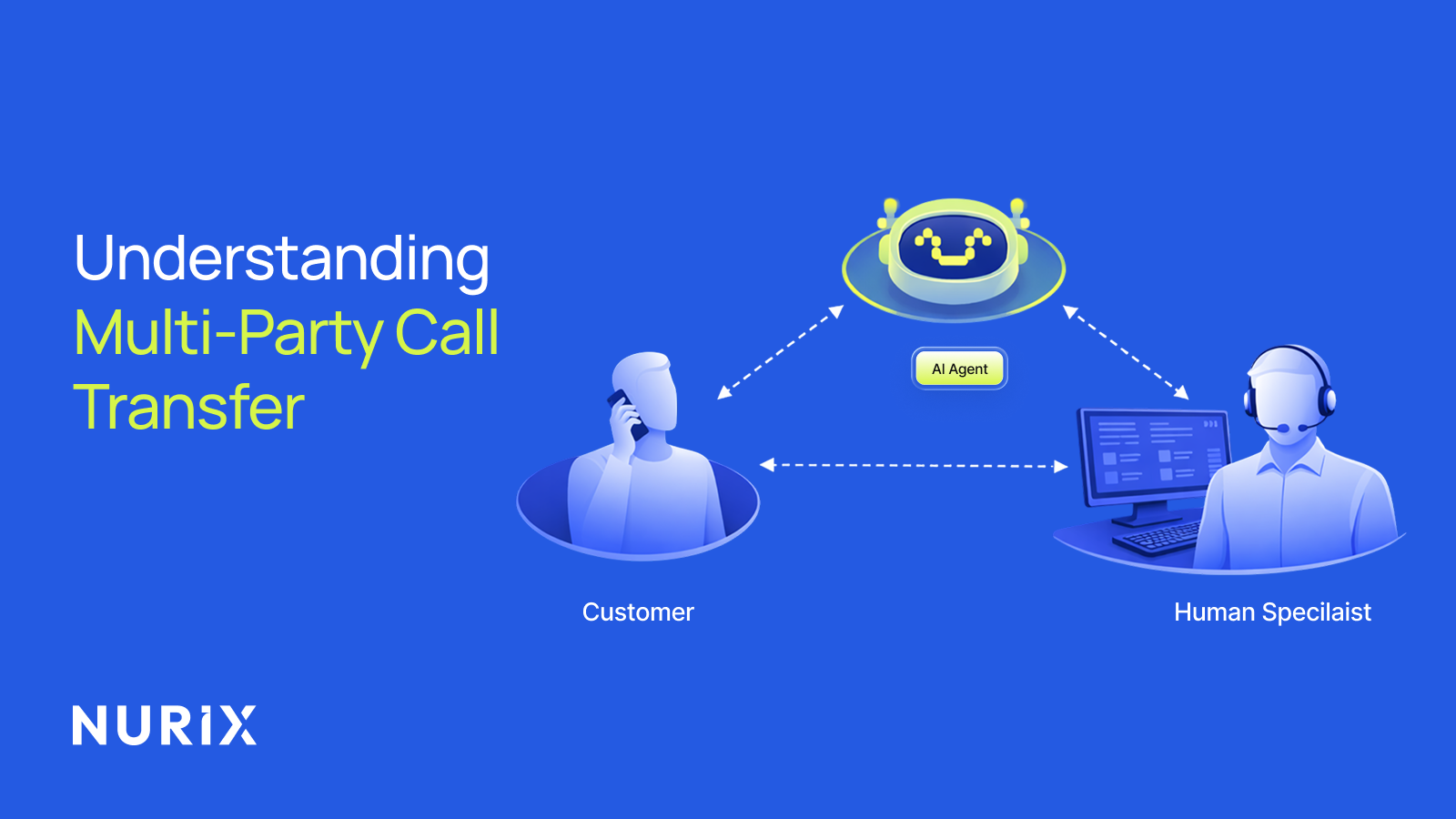
Multi-party call transfer is not an improvement to the existing transfer model. It is a replacement of the underlying assumption - that AI's role ends when a human enters the conversation.
In this model, AI operates as a continuous third participant. The customer, the specialist, and the AI agent are simultaneously part of the same live conversation. The AI does not hand off. It stays.
Before the Specialist Joins
The AI voice agent engages the customer from the first second, captures structured intent, verifies identity, and synchronizes with connected enterprise systems in real time. As the conversation unfolds, it is not just recording, it is organizing. Building a structured context record that will travel with the call.
When escalation is needed, the system identifies available specialists, prepares a complete interaction briefing, and connects the first qualified responder - all before the specialist says a word to the customer.
During the Live Conversation
Once the specialist joins, the AI remains active in the background. It surfaces relevant context on demand, retrieves account and policy information from integrated systems, and provides real-time next-best-action suggestions as the conversation develops. The specialist is informed, not catching up. They can focus entirely on resolution rather than rediscovery.
This is what makes multi-party call transfer structurally different from anything a routing system can deliver. Routing decides where the call goes. Orchestration determines what the call becomes.
How NuPlay Powers This at Enterprise Scale
NuPlay by Nurix AI is built specifically for enterprise-grade voice orchestration across the full conversation lifecycle.
Context That Travels With Every Call
NuPlay maintains structured conversational state across voice turns, identity verification steps, compliance checkpoints, and CRM updates in real time and without interruption. When a specialist joins, they enter a fully informed interaction. The conversation does not reset. It continues.
Deep Enterprise Integration
With over 300 integrations across CRM, ERP, and CCaaS platforms, NuPlay executes backend actions - updating customer records, triggering workflows, validating account data, processing transactional steps - entirely within the live call. Nothing requires a follow-up. Nothing falls through the cracks.
Built for Complexity and Scale
NuPlay operates across languages, retains context across voice, SMS, WhatsApp, and email channels, and maintains brand voice consistently across every interaction. It handles high-volume, routine conversations efficiently while ensuring that every escalation reaches a specialist with full context and zero repetition.
Nurix was recognized among the Top Agentic AI Companies of 2026 for its leadership in enterprise AI orchestration - a reflection of how the industry is beginning to recognize orchestration, not deflection, as the defining capability of next-generation contact centers.
The Measurable Shift
When multi-party call transfer replaces cold routing as the default transfer model, the impact is measurable across every metric that matters.
First Contact Resolution improves because specialists join with context and resolve issues in a single interaction. Average Handle Time falls because less time is spent rediscovering the problem. Repeat call volume drops because conversations are completed rather than abandoned mid-transfer. Call abandonment decreases because hold times shrink and handoffs are seamless. And the cost per resolved interaction comes down across the board.
McKinsey research indicates that properly implemented AI-enabled automation can reduce customer service operational costs by up to 30 percent. Multi-party call transfer is the architectural investment that makes that number achievable, not by deflecting more calls but by making every transferred call worth less to repeat.
In a contact center environment where margins are tight and customer expectations continue to rise, the transfer moment is no longer a detail. It is a strategic decision point.
Most systems move the call. Multi-party call transfer ensures the understanding moves with it.