
CFO's Conversational AI ROI Model: Deflection, Average Handle Time, and Customer Satisfaction Math in 2026
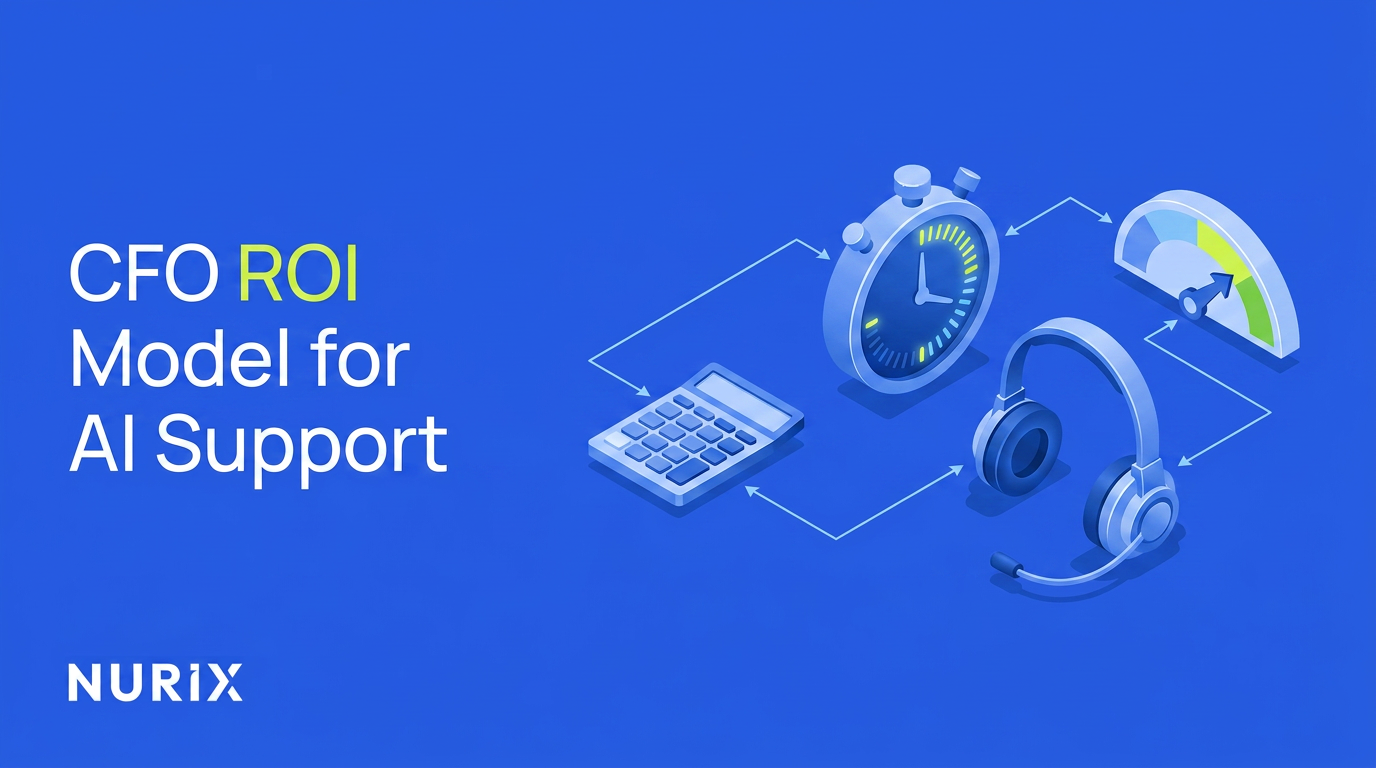
A conversational AI return on investment (ROI) model for enterprise deployments in 2026 rests on three inputs: deflection, average handle time (AHT), and customer satisfaction (CSAT). A 2026 customer service AI benchmark reports AI-resolved inquiries at $0.62 per resolution versus $7.40 for human agents, with AI average resolution time at 1.9 minutes versus 11.4 minutes for humans. Microsoft's summary of IDC's Business Opportunity of AI study found that organizations generate $3.70 in ROI for every $1 invested in generative AI. This guide provides the CFO-ready framework to calculate each variable against your own cost-to-serve baseline.
Building this model requires moving past basic automation metrics to calculate the true economic value of digital labor. Quantify deflection, measure reductions in average handle time (AHT), and connect customer satisfaction (CSAT) scores to revenue protection. Platforms like NuPlay (previously Nurix) make this possible by deploying enterprise-grade automation that completes actual workflows. This guide breaks down the framework CFOs can use to justify, measure, and scale conversational AI deployments.
What Is a Conversational AI ROI Model?
A conversational AI ROI model is a structured financial approach that converts AI performance into monetary outcomes. It compares the cost and value of resolving work with human labor versus digital labor, including setup, maintenance, integration, and operating effort.
A useful model ignores feature lists. It measures how much a deployment changes cost-to-serve, response speed, containment, sales throughput, and customer retention. That rigor helps CFOs approve enterprise-scale AI because the payback logic is explicit.
How the CFO ROI Model Works
The calculation depends on three connected variables: containment, efficiency, and experience. Start by establishing the current baseline. Know the cost per contact, contact volume, escalation rate, first-contact resolution rate, and customer experience score before modeling savings.
Deflection creates the first financial impact. If an AI agent resolves an inquiry without human intervention, the cost shifts from human handling to digital execution. AHT creates the second impact. If a case still reaches a human, AI can collect context, authenticate the caller, summarize the issue, and route the case so the agent resolves it faster.
These savings disappear if the system performs poorly. Slow responses, weak integrations, or inaccurate routing can force customers back to human agents. To prevent that, enterprises need an enterprise-grade orchestration engine designed for low-latency, governed workflows.
Key Metrics: Deflection, AHT, and CSAT
To build the model, isolate three primary inputs. Each metric needs clean tracking so the financial output is credible.
Deflection measures inquiries resolved without human intervention. The basic formula is: total interaction volume multiplied by the contained interaction rate, then multiplied by the fully loaded cost per contact.
Average handle time (AHT) measures efficiency gains on interactions that still reach humans. The basic formula is: remaining handled volume multiplied by minutes saved per interaction, then multiplied by the fully loaded cost per minute.
Customer satisfaction (CSAT) captures experience quality and downstream business value. Faster resolution and better routing can protect retention, reduce repeat contacts, and improve the value of every support or sales interaction.
Important Terminology and Concepts
Clarifying terminology is essential when presenting an ROI model to a board. Vague definitions lead to inaccurate projections.
Distinguish between automation rate and containment rate. Automation means the AI participated. Containment means the AI completed the interaction from start to finish without human help. CFOs should build savings models around true containment, not partial participation.
Calculate the fully loaded cost per contact. Include labor, benefits, management overhead, facilities, software, quality assurance, and escalation cost. The exact number should come from your own finance and operations data.
Account for hidden software costs. Existing platforms may add AI features as paid add-ons, while standalone enterprise AI platforms may present a cleaner operating model. CFOs should compare total deployment cost, not only license cost.
Real-World Enterprise Use Cases
Theoretical math matters only if it holds up in production. Across departments, the conversational AI ROI model proves value through operational improvements.
In high-volume support operations, the math favors automation when the agent can resolve real customer issues. Support Voice AI Agents can help teams handle order status, returns, address updates, subscriptions, billing questions, and triage without making customers wait for a human queue.
Sales teams apply a different ROI model focused on revenue generation. When AI agents handle outbound dialing, lead qualification, follow-up, and meeting scheduling, human representatives can focus on closing. Sales Voice AI Agents support that model by capturing intent, routing qualified leads, and updating revenue systems.
Document-heavy workflows also benefit. For contracts, requests for proposal (RFPs), research briefs, and finance approvals, AI agents can read, process, route, and deliver outputs with human review where needed.
Benefits and Business Importance
A defined ROI model transforms how an enterprise views artificial intelligence. It shifts the conversation from technology experiment to financial operating model.
It provides defensible data for budget approvals and board reviews. When a CIO requests funding, a model based on fully loaded costs and historical containment rates removes guesswork. The board can see what must be true for the deployment to break even.
It reveals the scalability advantage of full-stack AI platforms. Human labor scales in a near-linear way. AI labor can absorb more work after integration, governance, and orchestration are in place. That lets teams increase interaction capacity without adding the same level of headcount.
It also shows the opportunity value of reallocated labor. When routine interactions are automated, human agents can focus on retention, recovery, escalation, and cross-sell work that requires judgment.
Common Misconceptions About Conversational AI ROI
Despite the clear math, misconceptions can derail ROI calculations. The most common error is assuming ROI comes only from headcount reduction. A strong model also includes revenue protection, repeat-contact reduction, faster resolution, and customer experience improvements.
Another misconception is that all AI platforms perform equally. Consumer-grade tools can frustrate users and lower containment. Premium enterprise platforms should be grounded in business data, connected to systems of record, and governed for accuracy.
Finally, leaders forget that measurement requires deep integration. An AI agent cannot contain a call without access to underlying systems. To achieve true ROI, the AI must connect to CRM, ERP, and helpdesk systems, update records, and trigger actions. NuPlay supports this model with an orchestration layer that helps agents complete the work, not only discuss it.
Conclusion
A disciplined conversational AI ROI model built on deflection, AHT, and CSAT helps CFOs make confident, data-driven automation decisions. By focusing on the unit economics of digital labor, enterprises can deploy AI that cuts cost, protects revenue, and improves customer experience.
NuPlay is built for this operating model: enterprise-grade voice, chat, and workflow agents that connect to systems and complete real work. To map the ROI model to your support, sales, or internal operations workflows, request a NuPlay walkthrough.