How AI for Insurance Agents Is Changing the Game: Tools and Agents You Should Know


Don’t miss what’s next in AI.
Subscribe for product updates, experiments, & success stories from the Nurix team.
The insurance industry is experiencing a seismic shift. Generic AI chatbots and basic automation tools that seemed revolutionary just two years ago now feel inadequate. The reason? Agentic AI has arrived, and it's fundamentally changing what's possible in insurance operations.
This guide cuts through the hype. We'll explore the difference between AI tools and AI agents, review 10 platforms that insurance agencies are actually using, and help you decide when to buy off-the-shelf versus building custom solutions. Most importantly, we'll show you how to implement AI for insurance agents that actually delivers ROI.
At a glance:
- AI Agents Are Game-Changers: Unlike basic AI tools, agents autonomously anticipate, reason, and make decisions, transforming the insurance industry.
- Collaboration Is Key: Multi-agent systems allow specialized agents to collaborate, enhancing efficiency and reducing manual tasks across workflows.
- Voice AI Matters: With complex and urgent customer needs, voice AI agents bring empathy and expertise to insurance communication, often replacing chatbots in critical moments.
- Custom vs. Off-the-Shelf: Agencies need to decide whether to invest in custom-built AI solutions for tailored workflows or purchase off-the-shelf tools for standard operations.
- AI Is Here to Stay: AI tools and agents, such as Nurix AI, are increasingly integral to insurance operations, improving everything from claims processing to compliance tracking, thereby boosting productivity and client satisfaction.
AI Tools vs. AI Agents in the Insurance Industry
The conversation around AI in insurance needs an update. Most agencies are still shopping for "AI tools" when what they really need are "AI agents."
AI tools are static applications that perform specific tasks when you trigger them. Think of a chatbot that answers FAQs from a predetermined script, or document processing software that extracts policy data. They're useful, but limited.
AI agents are autonomous systems that make decisions, learn from interactions, and take actions without constant human input. They don't just respond, they anticipate, reason, and collaborate with other agents to complete complex workflows.
For example, an AI tool might flag a suspicious claim for human review. However, an AI agent investigates the claim, cross-references similar cases, checks compliance requirements, calculates risk scores, and either processes it automatically or escalates to a human adjuster with a complete briefing document already prepared.
As we move forward, it’s crucial to understand how multiple specialized AI agents work together to optimize operations, rather than relying on a single tool.
Multi-Agent Systems: How Specialized AI Agents Collaborate
The most advanced AI in insurance uses multi-agent systems. Instead of one AI trying to handle everything, specialized agents focus on their strengths. Here’s how it works:
- Intake agent: Qualifies leads and gathers info.
- Risk assessment agent: Analyzes exposure and flags concerns.
- Pricing agent: Calculates premiums based on market conditions.
- Compliance agent: Ensures every step meets regulations.
- Decision orchestrator agent: Coordinates everything, managing tasks and escalating when necessary.
This approach is already making waves in forward-thinking agencies, delivering real, measurable operational improvements. However, before choosing an AI agent platform, it’s important to know which AI agent categories can bring the most value to your agency.
While multi-agent systems provide the foundation for collaborative AI, it’s essential to understand the various types of AI agents that can be deployed within your insurance agency.
Essential AI Agent Categories for Insurance Professionals
Not every category is needed for every agency, but understanding what’s available helps you prioritize.
- Knowledge Management AI Agents: These agents are your agency’s memory. They pull up policy details, answer coverage questions, and retrieve past underwriting decisions. For example, when an agent asks about flood coverage exclusions, the AI provides an answer in seconds, not hours.
- Customer Communication Voice AI Agents: These agents, such as Nurix AI, handle customer inquiries via chat, email, or voice. They respond instantly, schedule appointments, send policy reminders, and escalate complex issues to humans with full context. The best implementations mimic human interaction seamlessly.
- Document Processing AI Agents: Insurance relies heavily on documents. These agents extract key data from forms, validate completeness, detect discrepancies, and route documents to the right people. They automate workflows, cutting days of manual work.
- Risk Assessment & Underwriting AI Agents: These agents analyze risk factors, compare policies, calculate exposure, and recommend coverage limits. They support underwriters by handling routine tasks and flagging cases that need human attention.
- Claims Processing AI Agents: Claims agents verify coverage, assess damage (including visual AI for property claims), calculate payouts, and detect fraud. They reduce cycle times while ensuring accuracy.
- Sales & Lead Management AI Agents: These agents qualify leads, manage follow-ups, and score leads based on conversion potential. They also suggest products and notify agents when prospects are ready to close.
- Compliance & Regulatory AI Agents: Compliance agents track regulatory changes, flag policies needing updates, and ensure documentation meets the latest standards across all jurisdictions.
- Training & Coaching AI Agents: These agents role-play with new hires, provide feedback on customer interactions, and identify knowledge gaps. They scale training efforts without adding headcount.
Now that we’ve discussed the various AI agent categories, let’s zoom in on one of the most overlooked yet crucial technologies: voice AI. Voice AI agents are critical for handling complex customer interactions, especially in moments requiring empathy and expertise—something that text-based AI struggles to match.
Voice AI Agents: The Missing Piece in Insurance Communication
While text-based AI grabs the spotlight, voice remains the primary channel for insurance interactions, especially for claims, policy questions, and complex sales. Yet, many agencies overlook voice AI altogether.
Why Voice Matters in Insurance
Customers turn to the phone when situations are urgent, complex, or emotional—like a car accident at 2 AM, a life insurance beneficiary needing help, or a business owner asking about coverage for a new venture. These aren't moments for chatbots; they require empathy, expertise, and a human touch.
Voice AI is now capable of handling these nuanced conversations, understanding natural speech, responding conversationally, and knowing when to escalate to a human.
Voice AI Capabilities for Insurance Agents
Modern voice agents can:
- Verify caller identity
- Pull up policy details
- Explain coverage
- Process routine changes
- Schedule appointments
- Collect claim info and transfer to specialists with full context
They work 24/7, never forget policy details, document every conversation, and improve with each interaction.
Integrating Voice AI with Chat and Email
The real power of voice AI shows when it’s integrated across all communication channels. A customer texts for a claim update, and the voice agent calls them back with the details.
They email a follow-up, and the same agent seamlessly continues the conversation. This creates a frictionless experience where customers never repeat themselves, no matter the channel.
As we’ve seen, voice AI enhances customer interaction in meaningful ways. But voice is just one piece of the puzzle. Let’s now examine a broader selection of AI tools that insurance agencies are leveraging to streamline operations, from document processing to fraud detection.
Top 10 AI Tools for Insurance Agents
The tools insurance agents rely on are quietly shifting from simple organizers to smart collaborators, offering insights and handling tasks that once demanded constant attention. Each has strengths and limitations—the key is matching capabilities to your specific needs.
1. Nurix AI
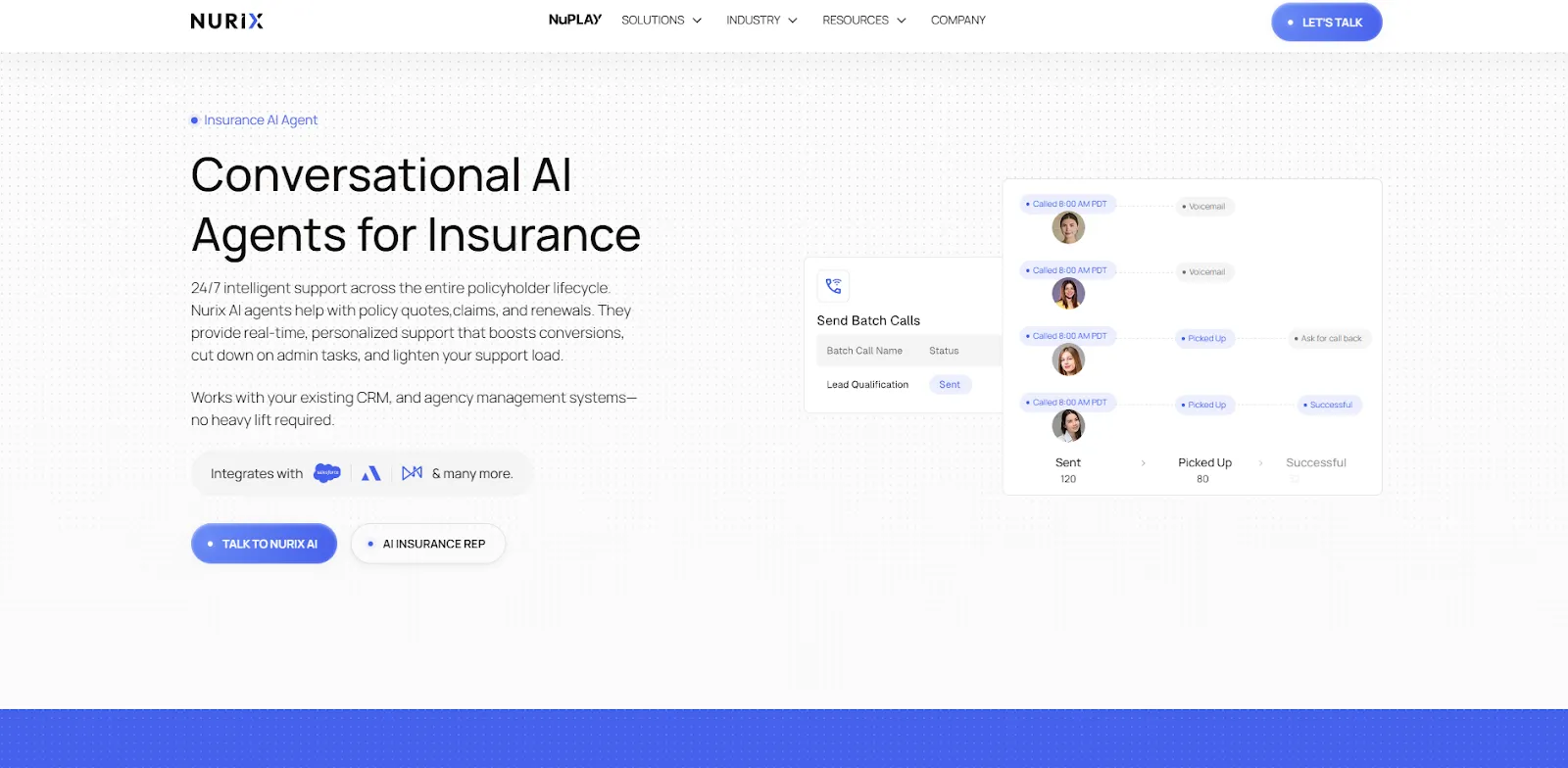
Nurix AI builds purpose-built, multi-agent AI systems trained specifically on your insurance agency's data, processes, and workflows. Unlike generic tools, Nurix AI creates custom agents that understand your unique underwriting guidelines, risk appetite, and customer service approach, delivering truly autonomous AI that learns and improves continuously.
- Multimodal FNOL (First Notice of Loss) Processing: Accepts claims via voice, chat, and document uploads, triggering automated triage and status updates.
- Lead Qualification & Dynamic Lead Scoring: Analyzes customer behavior and past policy data to identify high-potential leads and direct them to the most suitable agent, improving the chances of conversion.
- Custom LLM training: Tailored to your agency's specific data, ensuring the AI understands your unique processes and guidelines.
- Omnichannel communication: Supports voice, chat, and email for a seamless customer experience across all channels.
- MLOps infrastructure: Ensures continuous learning and adaptation to changing business needs.
- Flexible cloud deployment options: Private cloud, on-premises, or hybrid deployment to match your agency's preferences.
- Seamless integration with AMS/CRM systems: Easily connects with existing tools to enhance workflow and efficiency.
Best for: Mid-market to enterprise agencies serious about AI transformation; organizations with complex workflows that off-the-shelf tools can't handle; agencies requiring private cloud or on-premises deployment; insurance companies seeking competitive differentiation through proprietary AI capabilities.
2. Salesforce Agentforce
It extends Salesforce CRM with autonomous AI agents that handle customer service, sales, and operations tasks. It automates customer interactions, lead management, and workflow orchestration within your Salesforce environment.
Key AI capabilities:
- NLP for customer interactions
- Predictive analytics for sales forecasting
- Automated workflow orchestration
- Multi-agent coordination
- Integration with Einstein AI
Best for: Mid-market to enterprise agencies already using Salesforce CRM.
3. Knowmax
It is an AI-powered knowledge management platform for insurance agents to find policy details, coverage, and answers to customer queries instantly.
Key AI capabilities:
- Semantic search that understands intent
- Contextual content recommendations
- Multi-language support
Best for: Agencies with complex product portfolios or those onboarding new agents quickly.
4. Tractable
It uses computer vision AI to assess vehicle and property damage from photos, speeding up claims processing.
Key AI capabilities:
- Advanced image recognition for damage assessment
- Automated damage estimation
- Fraud detection
Best for: Auto and property insurers handling high claim volumes.
5. Hi Marley
It is a text messaging platform for insurance customer communication, enabling SMS for claims updates, document collection, and routine inquiries.
Key AI capabilities:
- Sentiment analysis
- Smart message routing
- Compliance-focused message archiving
Best for: Agencies focused on mobile-first customer experience and quick customer communication.
6. AgentFlow
It is a low-code platform automating insurance processes by connecting systems and orchestrating workflows.
Key AI capabilities:
- Intelligent workflow automation
- Automated task routing
Best for: Operations teams automating repetitive tasks and managing complex workflows.
7. Compliance.ai
It tracks regulatory changes and alerts insurance teams to compliance requirements in real time.
Key AI capabilities:
- Regulatory intelligence
- Automated change detection
Best for: Multi-state agencies in complex regulatory environments.
8. DocuSign
It is an industry-standard electronic signature platform with AI-powered features for insurance workflows.
Key AI capabilities:
- Document analysis and smart field placement
- Workflow automation for routing
Best for: Agencies needing digital signature workflows and remote signing.
9. Tomorrow.io
It provides hyperlocal weather data for insurance risk assessment and proactive customer communication.
Key AI capabilities:
- Hyperlocal weather forecasting
- Real-time alerts for severe weather
Best for: Property insurers in catastrophe-prone areas needing real-time weather intelligence.
10. Shift Technology
It specializes in AI-powered fraud detection and claims automation for global insurers. Its platform analyzes structured and unstructured data to flag anomalies and streamline claims workflows.
Key AI Capabilities:
- Spots suspicious patterns across claims, policies, and customer profiles.
- Automatically routes claims based on risk and complexity.
- Maintains detailed logs for compliance and investigation.
Best for: Global insurers focused on reducing fraud, improving claims efficiency, and ensuring regulatory compliance.
With a comprehensive overview of the tools available, the next decision agencies face is whether to buy off-the-shelf solutions or build custom AI agents tailored to their needs. This choice will depend on the complexity of their workflows and long-term strategic goals.
Building Custom AI Agents vs. Buying Off-the-Shelf Tools
This is the decision that determines whether AI becomes transformative or just another software expense.
When Off-the-Shelf Tools Are Sufficient
Buy tools when:
- You need a proven solution for a standard problem
- The tool integrates easily with your existing stack
- Your workflows match industry norms
- Speed to deployment trumps customization
- You're testing AI capabilities before a major investment
Off-the-shelf makes sense for commodity functions, electronic signatures, basic chatbots, and document storage. No need to reinvent the wheel.
5 Signs You Need a Custom AI Agent Solution
Build custom when:
- Your competitive advantage depends on unique processes that off-the-shelf tools can't replicate
- You're managing complex integrations across 5+ systems, and tool sprawl is becoming unmanageable
- Your workflows require context across multiple data sources that generic AI can't access
- You need agents that learn from your specific data and decisions to improve continuously
- Compliance or security requirements demand control over where data lives and how models operate
After understanding when custom AI agent solutions are necessary, it's time to explore how AI-driven tools can truly transform your agency's operations.
Overcome Operational Challenges with AI for Insurance Agents
Insurance agencies face rising operational costs, complex workflows, and pressure to deliver faster, personalized services. Traditional tools no longer meet the growing demands, and agencies need advanced technology to streamline operations, improve customer service, and ensure compliance.
Nurix AI addresses these challenges by automating routine tasks, improving accuracy, and enhancing customer experiences. Integrating AI agents helps reduce manual work, speed up claims processing, and boost customer satisfaction.
We offer:
- AI Agent Assist: Supports teams with real-time decision-making, handling queries, and providing relevant data.
- AI-Driven Customer Engagement: Manages end-to-end customer queries, recommends products, and resolves issues with minimal human input.
- Automated Data Analysis and Workflow Management: Analyzes data, uncovers patterns, and delivers actionable insights to optimize decisions.
- Multilingual Support: Supports 50+ languages to reach global customers.
- Voice AI with Biometric Authentication: Secures and personalizes customer interactions through voice recognition.
- Retrieval-Augmented Generation (RAG): Ensures accurate, context-aware responses based on approved knowledge bases.
- Advanced LLM Integration: Utilizes cutting-edge large language models for high-quality, context-sensitive interactions.
- Omnichannel Integration: Seamlessly integrates customer service across voice, text, and email.
- End-to-End Encryption: Protects sensitive data at every interaction stage.
- Multi-Factor Authentication: Enhances security for customer accounts.
- Compliance: Meets global regulations like GDPR, PCI-DSS, and CCPA.
- MLOps: Continuously improves models with regular retraining from new data.
Leverage AI to automate workflows, increase productivity, and enhance customer satisfaction. Book a demo now to explore AI-driven solutions for your insurance agency.

AI agents use advanced natural language processing combined with contextual learning to interpret subtle nuances in customer questions. When faced with ambiguity, they draw on historical interaction data and behavioral patterns to offer relevant responses. If uncertainty remains, they smoothly escalate the issue to human agents, ensuring no customer is left without accurate support.
Yes, AI for insurance agents tools analyze vast datasets in real-time, spotting patterns and anomalies that might elude human auditors. They use machine learning models trained on historical fraud cases to flag suspicious activities early, reducing false positives while improving detection rates. This proactive approach shortens claim cycles and protects the agency’s bottom line.
Rather than replacing agents, AI shifts its focus from administrative tasks to more strategic, relationship-driven roles. Agents need to develop skills in interpreting AI-generated insights and managing more complex client needs, which calls for ongoing training but also opens paths to higher-value work.
AI analyzes customer data beyond demographics, including behaviors and preferences, to create nuanced profiles. This enables agencies to offer products that closely match individual risk profiles and life circumstances, leading to better satisfaction and retention, while maintaining regulatory compliance.
Modern AI platforms embed encryption and anonymization techniques at their core, ensuring sensitive information stays protected throughout processing. They also maintain detailed audit trails and comply with industry regulations, allowing agencies to confidently use AI while upholding client trust and legal standards.
Don’t miss what’s next in AI.
Subscribe for product updates, experiments, & success stories from the Nurix team.