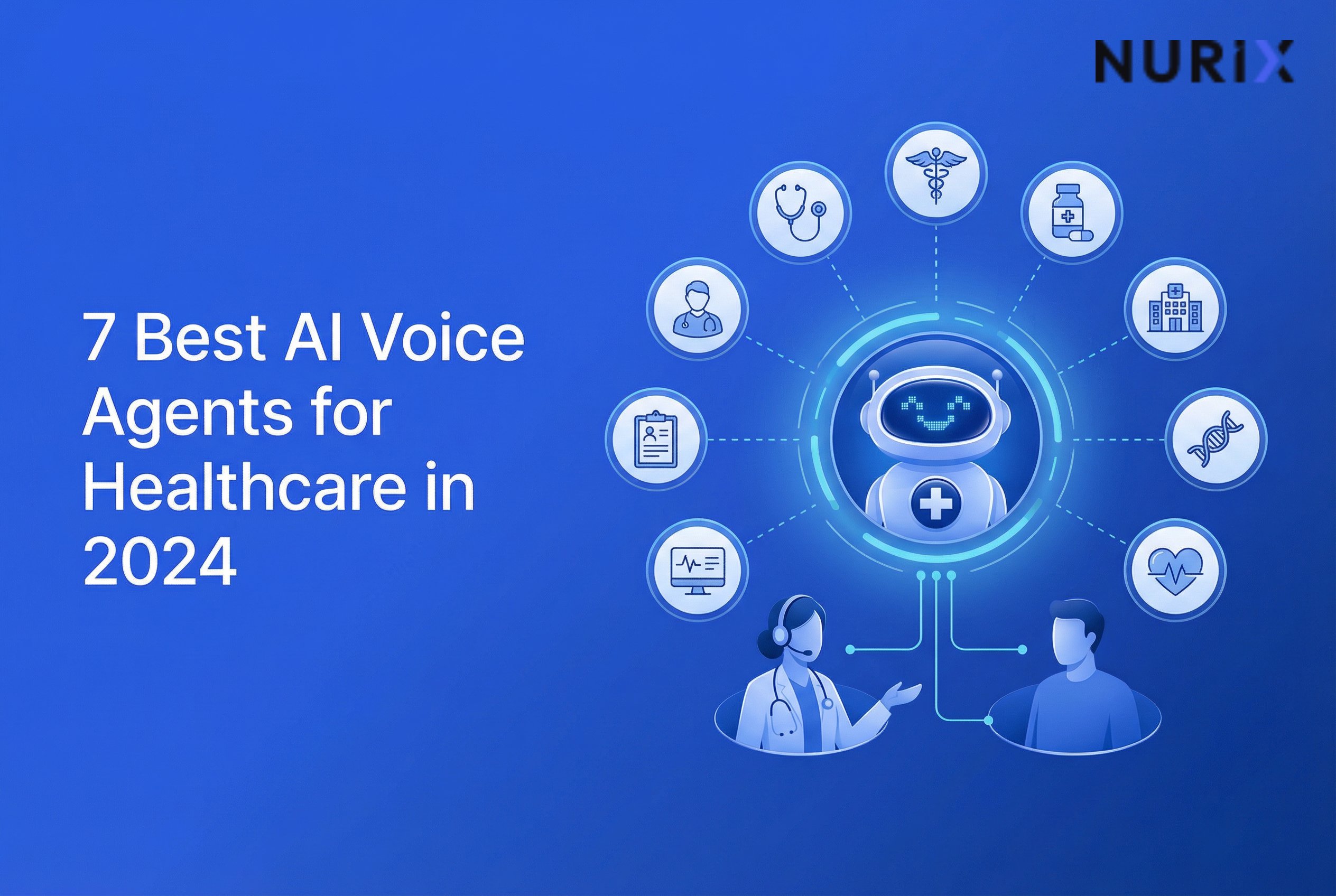

7 Best AI Voice Agents for Healthcare in 2026: HIPAA-Compliant Solutions Compared
Healthcare organizations handle thousands of patient calls daily. Staff spend hours on appointment scheduling, insurance verification, prescription refills, and after-hours triage — time that could go toward direct patient care. AI voice agents for healthcare automate these routine interactions while maintaining HIPAA compliance, reducing operational costs, and improving patient satisfaction scores.
After evaluating 7+ platforms across compliance, integration depth, voice quality, and scalability, here are the top solutions for 2026: Nuance DAX Copilot excels at clinical documentation for physicians drowning in notes. Infinitus dominates revenue cycle management and prior authorization automation. Nurix delivers full-stack workflow orchestration for enterprise healthcare operations and BPOs handling high call volumes. Each platform solves a different problem — your choice depends on whether you need to reduce documentation burden, improve billing operations, or automate end-to-end patient support.
The healthcare voice AI market grows from USD 468M in 2024 to a projected USD 3.18B by 2030 according to Grand View Research. The solutions below suit hospitals managing thousands of daily calls, clinics working to reduce no-shows, and BPOs scaling patient engagement without adding headcount.
Quick Verdict: HIPAA-compliant AI voice agents cut health system call-center costs by 35-60% and fully contain 55-75% of routine patient calls (scheduling, refills, billing), escalating clinical questions to a licensed clinician with full context preserved.
What Are AI Voice Agents for Healthcare?
AI voice agents for healthcare are conversational AI systems that handle patient interactions through natural, human-like voice. They schedule appointments, answer billing questions, triage symptoms based on clinical protocols, verify insurance eligibility, and complete administrative tasks — all without human intervention. Unlike rigid IVR systems that force patients through numbered menus, modern voice AI understands context, handles mid-sentence interruptions, and completes multi-step workflows autonomously.
Here is how a typical interaction works: a patient calls their provider's main line. The AI answers within one second using a human-like voice. It recognizes the caller's intent ("I need to reschedule my appointment for next Tuesday"), pulls up their record from the EHR in real-time, checks provider availability, confirms the new slot, and sends an SMS confirmation — all in under 90 seconds. If the query is clinically complex or the patient requests a human, the system escalates with full conversation context so the staff member does not start from scratch.
Healthcare voice AI differs from generic chatbots in several critical ways. First, HIPAA compliance: all PHI is encrypted in transit and at rest, with audit trails for every interaction. For a comprehensive overview of compliance frameworks, see our SOC 2, HIPAA, and TCPA compliance guide. Second, medical terminology understanding: the AI recognizes drug names, procedure codes, and clinical abbreviations without confusion. Third, deep integration with EHR systems like Epic, Cerner, and Athenahealth, enabling the agent to read and write patient data rather than just answer questions.
The underlying technology combines large language models for natural language understanding, neural text-to-speech for realistic voice output — the same foundation powering the best conversational AI platforms —, automatic speech recognition tuned for medical vocabulary, and workflow orchestration engines that connect to scheduling, billing, and clinical systems. Organizations deploying these solutions typically see 60-80% automation rates for routine calls, sub-second response latency, and 24/7 availability without overtime costs. For implementation guidance, see how to implement voice AI for customer service.
Research & Evidence
The AI voice agents healthcare market grows at 37.79% CAGR, driven by persistent staffing shortages (the U.S. faces a projected deficit of 100,000+ nurses by 2030) and rising patient demand for instant access. One implementation showed 40% reduction in booking time and 30% lower call abandonment rates.
Patient acceptance is strong and growing. American Heart Association research found 85% patient reach with 9/10 satisfaction scores for AI voice agents in health monitoring. Systematic reviews analyzing multiple studies report positive usability ratings, with patients consistently valuing 24/7 availability and reduced wait times over traditional phone trees.
On the operational side, organizations using voice AI report 30-50% reductions in call center staffing costs and average speed-to-answer improvements from minutes to seconds. The technology handles administrative burden at scale without replacing clinical staff — it redirects them to higher-value patient interactions.
How We Evaluated These Platforms
To rank these platforms, we assessed each across five weighted criteria relevant to healthcare deployments:
-
HIPAA Compliance & Security (25%): Does the platform sign BAAs? What certifications does it hold (HITRUST, SOC 2 Type II, ISO 27001)? How does it handle PHI encryption, audit logging, and data residency requirements?
-
EHR & System Integration (25%): How deeply does the platform integrate with Epic, Cerner, Athenahealth, and other clinical systems? Can it read and write patient data, or only surface information? Does it support HL7 FHIR and other healthcare interoperability standards?
-
Voice Quality & Conversational Ability (20%): How natural does the voice sound? Can it handle interruptions, topic changes, and multi-turn conversations? What is the response latency? Does it support medical terminology without misrecognition?
-
Scalability & Deployment (15%): Can the platform handle thousands of concurrent calls? What deployment options exist (cloud, on-premises, hybrid)? How long does implementation take? Is there a no-code or low-code configuration option?
-
Pricing & ROI Transparency (15%): Is pricing publicly available or custom-quoted? What is the typical implementation cost? Do published case studies include measurable ROI data? Is there a free trial or pilot program?
We reviewed vendor documentation, published case studies, analyst reports from KLAS Research and Gartner, and user feedback from G2 and KLAS. Platforms are ranked based on their combined score across these criteria for their primary use case, not as a universal ranking.
Top 7 AI Voice Agents for Healthcare
1. Nuance DAX Copilot: Best for Clinical Documentation
What it does: DAX Copilot uses ambient AI listening to capture clinician-patient conversations in real-time and automatically generate structured clinical notes (SOAP, HPI, assessment/plan) — without requiring dictation, typing, or any active input from the physician.
Key features: The core differentiator is the passive capture approach. The AI listens to a natural clinical encounter, understands medical context including drug names, dosages, and procedure terminology, and produces EHR-ready documentation in under 5 minutes for a typical 30-minute visit. Clinicians report saving an average of 2 hours daily on documentation, translating directly into more patient face time and less after-hours "pajama time" finishing notes. DAX Copilot integrates natively with Epic, Cerner, and the broader Microsoft Fabric for Healthcare data platform, enabling structured data to flow directly into the patient record without manual entry.
Compliance: HIPAA compliant with signed BAAs. HITRUST CSF certified. SOC 2 Type II audited. All ambient recordings are processed in Microsoft Azure's healthcare-compliant cloud environment and are not retained after note generation.
Pricing: Per-provider monthly licensing, typically in the range of $200-400/provider/month depending on volume commitments. Enterprise discounts available for health systems with 100+ providers.
Pros: - Ambient listening requires zero clinician workflow change - 99% transcription accuracy for medical terminology - Direct Epic and Cerner EHR write-back - KLAS Research Top Performer designation in clinical documentation - Reduces documentation time by approximately 50%
Cons: - Documentation-only — not a patient-facing voice agent for calls - Requires Microsoft Cloud infrastructure (Azure dependency) - Does not handle administrative tasks like scheduling or billing - Per-provider pricing adds up quickly for large health systems
Best for: Health systems with 50+ providers handling 20+ daily patient encounters who need to reduce documentation burden and clinician burnout. Particularly strong for primary care, urgent care, and specialty practices where note volume is highest.
2. Infinitus: Best for Revenue Cycle Management
What it does: Infinitus focuses specifically on automating revenue cycle operations — the billing calls, prior authorization requests, eligibility verifications, and collections follow-ups that consume 30-50% of healthcare administrative staff time. Its AI voice agents call payers and other providers on behalf of healthcare organizations to complete these transactions.
Key features: The platform's strength is outbound automation of the most time-consuming revenue cycle tasks. The AI agent dials insurance companies, navigates their IVR systems, waits on hold, and completes benefit verification, claims status inquiries, prior authorization submissions, and payment follow-ups. One health system reported cutting revenue cycle staffing by 40% while increasing collections by 20%. The platform processes prior authorizations up to 90% faster than manual workflows and maintains detailed audit trails for every call.
Compliance: HIPAA compliant with signed BAAs. HITRUST CSF certified, which represents the gold standard for healthcare information security. SOC 2 Type II audited. All call recordings and transaction data encrypted at rest and in transit.
Pricing: Enterprise ROI-based pricing model — Infinitus typically structures deals around demonstrated savings, making initial adoption lower-risk. Expect custom quotes based on call volume and transaction types.
Pros: - Automates the highest-friction revenue cycle tasks end to end - 25% average increase in collections recovery - 90% reduction in prior authorization processing time - HITRUST certified with full audit trail - Integrates with Epic, Cerner, and Athenahealth billing modules
Cons: - Revenue cycle only — does not handle patient-facing scheduling, triage, or support calls - Requires high monthly billing volume (10,000+ transactions) to justify implementation cost - Outbound-focused — limited inbound patient call capabilities - Custom pricing means longer procurement cycles
Best for: Revenue cycle managers and CFOs at health systems processing 10,000+ monthly billing transactions who struggle with collections rates, prior auth delays, or excessive staffing costs in their billing department.
3. Nurix: Best for Enterprise Healthcare Operations
What it does: Nurix provides full-stack voice AI with end-to-end workflow orchestration for healthcare organizations and BPOs that need to automate not just conversations but the entire operational workflow behind them — from scheduling and triage to CRM updates, follow-up triggers, and multi-system data synchronization.
Key features: Where most voice agents stop at conversation, Nurix completes the transaction. The platform schedules appointments directly in Epic, updates patient records in Cerner, triggers automated follow-up sequences, and routes urgent cases to on-call staff with full conversation context. The proprietary NuVoice engine delivers sub-400ms response latency with natural interruption handling, so patients can speak mid-sentence without the AI losing context. NuPulse, the built-in analytics suite, tracks patient sentiment, intent classification accuracy, automation rates, and call quality in real-time — giving operations teams granular visibility into performance. Organizations running 1,000+ daily calls through Nurix report 70%+ automation rates for routine interactions and 35-45% reductions in average handle time.
Compliance: HIPAA compliant with signed BAAs. SOC 2 Type II certified. Supports hybrid deployment (cloud + on-premises) for organizations with strict data residency requirements, which is critical for healthcare systems operating under state-level privacy regulations beyond HIPAA.
Pricing: Custom enterprise pricing with options for per-call, per-minute, or flat monthly models depending on volume. Offers pilot programs for proof-of-concept deployments. On-premises deployment available for organizations that cannot use public cloud.
Pros: - Full workflow automation beyond conversation — CRM updates, scheduling, routing, and follow-ups - Sub-400ms latency with human-like voice and emotion detection - Hybrid cloud/on-prem deployment for data residency compliance - NuPulse real-time analytics for continuous optimization - Deep EHR integration with Epic, Cerner, and Athenahealth
Cons: - Enterprise pricing structure is cost-prohibitive for small clinics and solo practices - Complex EHR integrations require dedicated implementation planning (typical 8-12 week deployment) - Steeper learning curve for operations teams compared to no-code alternatives
Best for: Healthcare BPOs and large hospital systems managing 1,000+ daily patient calls that need end-to-end automation — not just answering calls, but completing the full operational workflow with HIPAA compliance and deep EHR integration.
4. Poly AI: Best for Multilingual Patient Engagement
What it does: Poly AI specializes in enterprise-grade conversational voice agents with industry-leading multilingual capabilities, supporting 50+ languages with dialect-level accuracy. It is built for healthcare organizations serving linguistically diverse patient populations where language barriers directly impact care access and outcomes.
Key features: The platform's core strength is handling complex, multi-turn conversations where patients interrupt, change topics, or switch languages mid-call — behaviors that break most voice AI systems. Poly AI handles medical queries in Spanish, Mandarin, Arabic, Vietnamese, and dozens of other languages with contextual understanding of healthcare terminology in each language. The platform integrates with major CCaaS infrastructure (Genesys, Amazon Connect, Five9, NICE), making it a natural fit for organizations already running contact center operations. Healthcare deployments report 30-40% reductions in average handle time and significant improvements in patient satisfaction scores among non-English-speaking populations.
Compliance: HIPAA compliant with signed BAAs. SOC 2 Type II certified. Data processing agreements available for international deployments subject to GDPR or other regional privacy regulations.
Pricing: Enterprise volume-based pricing with custom quotes. Typically structured as per-conversation or per-minute pricing with volume tiers. No self-serve or SMB tier available.
Pros: - 50+ languages with dialect-level recognition and medical vocabulary - Handles complex multi-turn conversations with natural interruptions and topic changes - Deep CCaaS integration with Genesys, Amazon Connect, Five9, and NICE - 30-40% average handle time reduction across deployments - Strong NLU specifically tuned for healthcare queries
Cons: - Enterprise pricing model excludes small practices and independent clinics - Requires existing CCaaS infrastructure for full functionality - Less suited for organizations with a primarily English-speaking patient base - Implementation timeline of 6-10 weeks for healthcare-specific customization
Best for: Hospitals and healthcare BPOs with 1,000+ daily calls serving diverse patient populations — particularly in areas like California, Texas, Florida, and New York where multilingual support directly impacts patient access and CAHPS scores.
5. Hyro: Best for No-Code Deployment
What it does: Hyro provides a no-code platform for building and deploying HIPAA-compliant voice AI agents, designed specifically for healthcare organizations that lack dedicated AI engineering teams but still need to automate patient interactions quickly.
Key features: The visual workflow builder lets non-technical staff — operations managers, call center supervisors, IT generalists — create voice agents for patient intake, appointment scheduling, prescription refill requests, and appointment reminders without writing code. Hyro's "plug and play" approach connects to Epic and Cerner via pre-built connectors, reducing implementation from months to weeks. Healthcare organizations using Hyro report measurable intake time reductions and improved show-up rates through automated appointment reminders. The platform also provides a conversational analytics dashboard showing call volumes, automation rates, and drop-off points.
Compliance: HIPAA compliant with signed BAAs. SOC 2 Type II certified. All data processed in HIPAA-compliant cloud environments with encryption at rest and in transit.
Pricing: Mid-market pricing positioned below enterprise-only competitors. Offers tiered plans based on call volume, making it accessible to mid-sized hospitals, multi-location clinics, and telehealth platforms. Free pilot programs available for qualified healthcare organizations.
Pros: - True no-code builder accessible to non-technical healthcare staff - Pre-built EHR connectors for Epic and Cerner reduce integration effort - Measurable intake time reductions and appointment show-up improvements - Fastest deployment timeline among platforms reviewed (2-4 weeks typical) - Mid-market pricing accessible to organizations below enterprise scale
Cons: - Limited capability for complex, multi-step workflows compared to platforms like Nurix or Sierra - Smaller partner and integration ecosystem than more established competitors - May require upgrading to enterprise tier as call volumes grow - Less suitable for organizations needing deep customization or on-prem deployment
Best for: Mid-sized hospitals, multi-location clinics, and telehealth platforms with 500+ daily patient interactions that need to deploy voice automation quickly without dedicated AI engineering resources.
6. Gnani.ai: Best for Global Healthcare Operations
What it does: Gnani.ai provides voice-first AI agents supporting 100+ languages and dialects, designed for healthcare organizations and BPOs operating across multiple countries or serving highly diverse patient populations where cultural context matters as much as language accuracy.
Key features: The platform goes beyond translation to deliver hyper-personalization across languages with cultural context awareness — understanding not just what a patient says but how communication norms differ across cultures. Gnani.ai reports high intent accuracy across its supported languages and significant AHT reductions for multilingual patient bases. The platform handles everything from appointment scheduling to symptom triage in languages including Hindi, Tagalog, Arabic, Bengali, and dozens more. It integrates with major CCaaS platforms (Genesys, Avaya) and healthcare systems (Epic), providing a unified platform for organizations operating across borders.
Compliance: HIPAA compliant with signed BAAs for U.S. healthcare deployments. Supports GDPR compliance for European operations. Recognized by Gartner in conversational AI market assessments. SOC 2 Type II certified.
Pricing: Enterprise pricing with custom quotes based on language count, call volume, and deployment complexity. Higher price point for deployments requiring 20+ languages versus core language packages.
Pros: - 100+ languages with high intent classification accuracy - Cultural context awareness beyond literal translation - HIPAA-compliant with Gartner recognition in conversational AI - Low latency and high uptime SLAs (99.9%+) - Unified platform for voice, chat, and email automation
Cons: - Enterprise pricing may be prohibitive for single-market organizations - Requires CCaaS infrastructure for contact center deployments - Smaller U.S. healthcare-specific case study portfolio compared to domestic competitors - Language quality can vary across less common dialects
Best for: Healthcare BPOs and telehealth platforms serving immigrant communities, international patient populations, or operating across multiple countries where 10+ languages are required for effective patient communication.
7. Sierra AI: Best for Enterprise Patient Support
What it does: Sierra AI uses agentic AI architecture to autonomously reason through, plan, and execute multi-step patient support tasks — resolving complex inquiries that scripted systems cannot handle, without relying on decision trees or pre-programmed flows.
Key features: Sierra's core differentiator is autonomous resolution capability. The AI agent independently accesses multiple backend systems, reasons through complex scenarios (such as a patient asking to reschedule an appointment, update their insurance on file, and request a prescription refill in a single call), and executes each step without human intervention. Sierra reports that deployments achieve up to 70% first-contact resolution rates with 50% reductions in average handle time. When escalation is necessary, the system transfers to a human agent with complete conversation context, patient history, and a summary of steps already completed. This human-in-the-loop approach is critical for clinical safety scenarios. The company has raised USD 110M at a USD 4.5B valuation, signaling strong investor confidence in the agentic AI approach.
Compliance: HIPAA-compliant architecture with signed BAAs. SOC 2 Type II certified. Data encryption at rest and in transit with configurable data retention policies.
Pricing: Enterprise pricing with custom quotes. Given the company's funding stage and enterprise focus, expect premium pricing relative to more established healthcare-specific platforms. Pilot programs available.
Pros: - Autonomous multi-step task execution without scripts or decision trees - High first-contact resolution rates reducing escalation volume - 50% average handle time reduction across deployments - Context-preserving escalation when human handoff is needed - USD 4.5B valuation reflects strong product and market confidence
Cons: - Enterprise-only focus limits accessibility for mid-market organizations - Newer entrant in healthcare specifically — less healthcare-specific case study data than veterans like Nuance - Premium pricing may exceed budget for organizations with straightforward automation needs - Agentic approach requires careful guardrailing for clinical safety scenarios
Best for: Large healthcare enterprises with 500+ support agents and complex patient interaction workflows that need autonomous resolution capabilities beyond what scripted or template-based systems can deliver.
Comparison Table
How to Choose the Right AI Voice Agent for Your Healthcare Organization
Start with your primary pain point. If clinician burnout from documentation is your top issue, Nuance DAX Copilot is the clear choice — it is purpose-built for that problem. If collections and prior authorization delays are bleeding revenue, Infinitus addresses that workflow specifically. For organizations needing full operational automation across scheduling, triage, and support, Nurix delivers the deepest workflow orchestration. Multilingual patient populations are best served by Poly AI (for CCaaS-integrated environments) or Gnani.ai (for global, multi-country operations).
Assess your technical resources honestly. Hyro enables non-technical teams to deploy voice automation in 2-4 weeks with no code. Nurix and Sierra AI offer more power and flexibility but require dedicated integration efforts spanning 8-12 weeks. If you lack an IT team that can support a complex implementation, prioritize Hyro's no-code approach and upgrade later as needs grow.
Evaluate compliance requirements beyond HIPAA. Every platform on this list is HIPAA compliant, but requirements vary. If you need HITRUST certification specifically (common for payer relationships), Nuance and Infinitus carry that certification. If you operate internationally and need GDPR compliance, Gnani.ai supports both HIPAA and GDPR. For organizations with strict data residency requirements, Nurix's hybrid cloud/on-premises deployment option may be the deciding factor.
Consider your call volume and budget. Most platforms on this list are enterprise-priced, with custom quotes starting in the five-figure annual range. Hyro is the notable exception with mid-market tiered pricing. If your organization handles fewer than 500 daily calls, start with Hyro or a pilot program from one of the enterprise vendors before committing to a full deployment.
Plan for integration depth. The value of voice AI multiplies when the agent can read and write data directly in your EHR, billing system, and CRM. Prioritize platforms with pre-built connectors for your specific systems (Epic, Cerner, Athenahealth) rather than those requiring custom API development. Ask vendors about HL7 FHIR support, bidirectional data sync, and real-time versus batch updates during evaluation.
Choosing the Right Platform
The seven platforms reviewed here represent fundamentally different philosophies for deploying voice AI in healthcare. Some, like Nuance DAX and Infinitus, have spent years accumulating deep clinical workflow integrations and regulatory certifications. Others, like Nurix and Sierra AI, bring modern enterprise architecture with flexible deployment models that appeal to organizations building long-term AI infrastructure. Hyro occupies a distinct niche by making voice automation accessible to teams without engineering resources.
The right choice depends on where your organization sits today and where it needs to be in 18 months. If your primary bottleneck is clinician documentation and you run Epic or similar EHR systems, Nuance's ambient listening capabilities solve an immediate, measurable problem. If your challenge is high-volume administrative calls — appointment scheduling, insurance verification, prescription refills — Infinitus and Gnani.ai offer purpose-built automation for those specific workflows. For organizations that need a unified voice AI layer across multiple departments and use cases, Nurix and Sierra AI provide the architectural flexibility to scale horizontally without deploying separate point solutions.
Start with a 30-day pilot on your highest-volume workflow and measure against your current cost-per-interaction baseline. Track not just call deflection rates but patient satisfaction scores, staff time recovered, and error rates on tasks like scheduling or eligibility checks. These metrics will tell you whether a platform delivers real operational value or simply shifts complexity from one team to another.