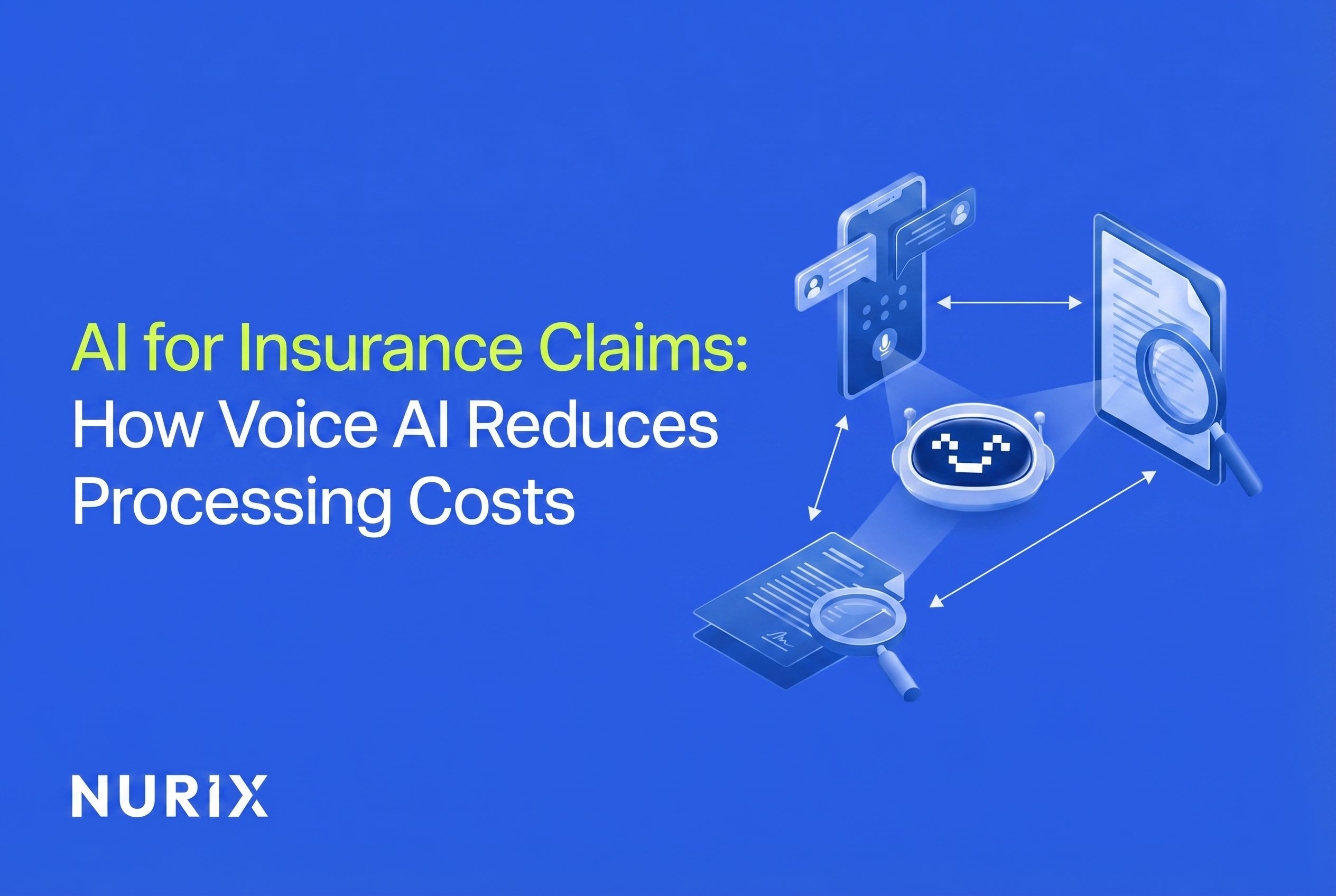

AI for Insurance Claims: How Voice AI Reduces Processing Costs
Insurance carriers process millions of claims every year, and the cost of handling each one continues to climb. Manual data entry, back-and-forth phone calls, document chasing, and fraud investigations all add up.
The average claim costs insurers $40 to $60 to process manually. Multiply that across a book of business and the inefficiency becomes staggering.
AI for insurance claims is no longer a futuristic concept. It is the operational lever that forward-thinking carriers are pulling right now to cut processing costs by 30-40%, resolve claims in days instead of weeks, and keep policyholders from switching to competitors.
In this guide, we break down exactly how voice AI and intelligent automation are reshaping claims operations. We cover where the biggest ROI opportunities sit and how to avoid the pitfalls that derail most insurance AI pilots.
Quick Verdict: Insurers deploying AI across the claims lifecycle are seeing cost-per-claim reductions of 30-40% and resolution times dropping from 30 days to under 8 days. Voice AI delivers the fastest wins at the front end — automating First Notice of Loss (FNOL) intake, cutting handling times by up to 8x, and enabling 24/7 claims reporting without additional headcount.
The Claims Processing Problem No One Wants to Talk About
Insurance claims processing has been stuck in the same paradigm for decades. A policyholder calls in, waits on hold, and explains their situation to an agent who types notes into a system. The claim then enters a queue.
Documents get requested, mailed, scanned, and re-keyed. Adjusters review files, request more information, and eventually reach a decision. The whole cycle averages 32.4 days for property claims in 2025 — up from 23.9 days the year prior.
The cost structure is equally painful. Loss adjustment expenses (LAE) consume a significant portion of every premium dollar collected, and McKinsey estimates that AI could cut operational costs by up to 40% by 2030. Yet full AI adoption across the industry sits at just 34%, up from a mere 8% the previous year. The gap between early adopters and laggards is widening fast.
Meanwhile, policyholders are losing patience. Accenture research found that consumers dissatisfied with claims experiences represent up to $170 billion in at-risk premiums over a five-year window. The message is clear: the traditional claims model is a cost center, a churn driver, and a competitive liability all at once.
How AI Transforms Every Stage of Claims Processing
AI for insurance claims is not a single technology — it is a set of capabilities that can be deployed across the entire claims lifecycle. Here is where the biggest impact areas sit.
First Notice of Loss (FNOL) Intake
FNOL is the moment of truth in any claim. The policyholder is stressed, the insurer needs accurate data, and speed matters. Traditionally, FNOL relies on call center agents working through scripted intake forms during business hours. Voice AI changes this entirely.
For a deep dive into AI-powered FNOL claims automation, see our dedicated guide on streamlining the intake process. AI-powered voice agents can handle FNOL calls 24/7, capturing claim details through natural conversation, verifying policy information in real time, and initiating downstream workflows automatically.
Insurers using voice AI for FNOL have reported an 8x decrease in handling times and a 30% reduction in operational costs at the intake stage alone. The policyholder gets immediate acknowledgment and a claim number, while the insurer gets structured, validated data from the first interaction.
This is where a platform like NuPlay (previously Nurix) makes a measurable difference. NuPlay's voice AI agents are purpose-built for high-stakes enterprise conversations — not generic chatbot interactions. They handle the nuance of insurance intake:
- Empathetic tone with a distressed caller
- Accurate capture of incident details
- Seamless handoff to a human adjuster when the situation requires it
NuRep ensures every agent interaction maintains brand-appropriate tone, regulatory compliance, and behavioral consistency across all policyholder touchpoints.
Intelligent Document Processing
After FNOL, claims generate a flood of paperwork — police reports, medical records, repair estimates, photos, and invoices. Manually reviewing and extracting data from these documents is one of the most labor-intensive steps in claims handling.
AI-powered document processing uses optical character recognition (OCR), natural language processing, and machine learning to automate this work. These systems can:
- Extract key data fields from unstructured documents in seconds
- Classify documents by type (medical report, police filing, invoice, etc.)
- Validate extracted information against policy records
- Flag discrepancies for adjuster review
The speed gains are significant. AI-powered photo estimation now delivers damage assessments within 24 hours for 78% of claims, compared to 5-7 days for traditional inspection.
When combined with voice AI at the front end — where the system can prompt callers to upload photos during the FNOL call itself — the entire intake-to-assessment cycle compresses dramatically.
Fraud Detection and Prevention
Insurance fraud costs the industry over $308 billion annually, translating to roughly $950 in increased premiums for the average American family. Traditional fraud detection relies on rules-based systems and manual red-flag reviews, which catch obvious cases but miss sophisticated patterns.
AI-driven fraud analytics use machine learning models trained on millions of claims to identify anomalies, cross-reference data sources, and flag suspicious claims in real time. These models detect patterns that human reviewers cannot see at scale:
- Coordinated fraud rings submitting similar claims across different regions
- Inconsistencies between reported damage and photographic evidence
- Unusual timing patterns in claim submissions
- Cross-referencing claimant history across carriers
The savings potential is massive. Deloitte estimates that P&C insurers could save up to $160 billion by 2032 by deploying AI-driven, real-time fraud analytics.
Voice AI adds another detection layer — analyzing caller sentiment, speech patterns, and consistency of narrative during FNOL to identify potential fraud signals before a claim even enters the system.
Settlement and Resolution
The final stage — determining the payout and closing the claim — is where delays compound and customer satisfaction craters. AI accelerates settlement by automating reserve calculations, generating payout recommendations based on historical data, and routing straightforward claims for auto-adjudication.
McKinsey projects a 25-30% reduction in loss adjustment expenses and a 3-5 percentage point decrease in indemnity spend for carriers deploying AI-driven reserve modeling. For a carrier with a $500 million claims portfolio, even a 5% improvement in reserve accuracy frees up $25 million in capital.
AI Impact Across the Claims Lifecycle
Why Voice AI Is the Highest-ROI Entry Point
Many insurers start their AI journey with back-office automation — document processing, data analytics, workflow optimization. These are valuable, but they miss the highest-leverage point: the customer interaction layer.
See our analysis of voice AI agents in the insurance industry for a broader look at how voice technology is reshaping carrier operations beyond claims. Voice AI sits at the intersection of cost reduction and customer experience improvement, which is why it delivers outsized returns.
Here is the math: if your call center handles 50,000 FNOL calls per month at an average handling time of 12 minutes, and voice AI reduces that to 3 minutes while handling 60% of calls autonomously, the savings in agent time alone are massive. That is before you factor in 24/7 availability, reduced errors, and faster cycle times.
The key distinction is between generic chatbots and purpose-built AI agents. A basic chatbot can answer FAQs. A voice AI agent built for insurance can conduct a full FNOL intake, authenticate the caller, pull policy details, capture incident specifics, schedule an adjuster, and send confirmation — all in a single call. NuPlay's AI agents are designed for exactly this kind of complex, multi-step enterprise workflow.
What makes the difference is orchestration — the ability to coordinate multiple AI capabilities (voice understanding, data retrieval, decision logic, handoff protocols) into a seamless experience. This is what NuPilot, NuPlay's orchestration layer, handles. It ensures that voice AI agents do not operate in isolation but are integrated into your claims management system, policy administration platform, and adjuster workflows.
The ROI Case: What the Numbers Actually Look Like
Let's put concrete numbers on the opportunity. Consider a mid-size P&C carrier processing 200,000 claims annually.
Before AI:
- Cost per claim: $50 (manual processing across intake, document review, and adjudication)
- Average resolution time: 30 days
- Fraud losses: Undetected fraud at scale on a $500M book of business
- Customer retention: High churn driven by slow, frustrating claims experiences
After AI:
- Cost per claim: ~$32.50 (AI-assisted processing) — a 35% reduction saving $3.5M annually
- Average resolution time: 10 days — improved cash flow and fewer supplemental claims
- Fraud losses: AI catches 2% more fraudulent claims — $10M in avoided payouts
- Customer retention: Faster, smoother claims experience protects share of $170B in at-risk premiums
NuPulse, NuPlay's conversation intelligence engine, gives carriers real-time visibility into these metrics — tracking cost per claim, resolution time, customer satisfaction scores, and agent performance across every AI-assisted interaction. Without this kind of measurement layer, it is impossible to demonstrate ROI to the board and justify continued investment.
Successful AI adoption in insurance claims requires a phased rollout approach.
A Practical Implementation Approach
While the ROI potential is clear, successful AI adoption in claims requires a phased rollout — not a big-bang deployment. The carriers seeing the best results follow a structured, incremental approach.
Phase 1: Voice AI for FNOL (Weeks 1-8)
Start where customer impact and cost savings intersect. Deploy voice AI agents to handle inbound FNOL calls for a specific line of business — auto claims is often the best starting point due to high volume and relatively standardized intake.
Integrate with your existing claims management system so that AI-captured data flows directly into adjuster queues. Measure handling time, data accuracy, customer satisfaction, and containment rate.
Phase 2: Document Processing and Triage (Weeks 6-14)
Layer in intelligent document processing to automate the post-FNOL workflow. Use AI to extract data from submitted documents, auto-classify claim types, and route to the appropriate adjuster or auto-adjudication path. This phase typically overlaps with Phase 1 as you expand voice AI coverage.
Phase 3: Fraud Detection and Analytics (Weeks 10-20)
Deploy ML-based fraud scoring models that run against every incoming claim. Integrate fraud signals with your existing SIU (Special Investigations Unit) workflow. Use voice AI interaction data as an additional input to fraud models.
Phase 4: End-to-End Orchestration (Weeks 16-24)
Connect all components into a unified, orchestrated workflow where claims flow from FNOL through processing, triage, investigation, and settlement with minimal manual intervention. This is where AI agent orchestration becomes critical — coordinating multiple AI capabilities, human touchpoints, and system integrations into a coherent process.
Why Most Insurance AI Pilots Fail — and How to Avoid It
Here is an uncomfortable truth: the majority of AI pilots in insurance never make it to production. In Episode 30 of Nex by Nurix — "Why AI Pilots Fail" — the team dives deep into the systemic reasons that promising AI initiatives stall out. The patterns are consistent across carriers.
Pilot purgatory. Teams build a proof of concept that works in a controlled environment, declare success, and then spend months trying to integrate it with legacy systems. The pilot never scales because it was never designed to.
Wrong success metrics. Pilots measured on "accuracy in a lab" instead of business outcomes (cost per claim, handling time, customer satisfaction) produce impressive demos but no operational value.
Insufficient data infrastructure. AI models are only as good as the data they consume. Carriers with fragmented claims data across multiple systems, inconsistent coding, and poor data quality hit a wall before they even get to model training.
Change management failure. Adjusters and call center agents who feel threatened by AI become blockers. Successful implementations position AI as a tool that eliminates tedious work and lets experienced professionals focus on complex, high-value claims.
The carriers that succeed treat AI deployment as a product initiative, not a technology experiment. They set clear business KPIs from day one, integrate with production systems from the start, and invest as much in change management as they do in technology.
NuPlay's implementation methodology is built around these principles — starting with a focused use case, proving business value quickly, and expanding from a position of demonstrated ROI.
Choosing the Right AI Platform for Claims
Not all AI platforms are created equal, and insurance claims processing has specific requirements that generic AI tools cannot meet. When evaluating platforms, look for:
Enterprise-grade voice AI. The platform must handle real-time voice conversations with the accuracy, latency, and reliability that insurance calls demand. Consumer-grade chatbots are a starting point, but claims intake requires purpose-built voice agents that can manage complex, emotionally charged interactions.
Regulatory compliance. Insurance is a regulated industry. Your AI platform must support call recording, audit trails, consent management, and compliance with state-specific regulations. Data residency and security certifications (SOC 2, HIPAA where applicable) are non-negotiable.
Integration depth. The platform must connect to your claims management system, policy administration system, document management platform, and CRM. API-first architecture and pre-built connectors for major insurance platforms (Guidewire, Duck Creek, Majesco) dramatically reduce implementation time.
Orchestration capabilities. As discussed, the ability to coordinate multiple AI capabilities, human handoffs, and system integrations in a single workflow is what separates platforms that deliver results from those that create another silo. NuPilot provides this orchestration layer, ensuring that voice AI, document processing, analytics, and human workflows operate as a unified system.
Analytics and observability. You need real-time visibility into every AI-assisted interaction — not just for ROI measurement, but for continuous improvement, compliance monitoring, and exception handling.
What Comes Next: The AI-Native Carrier
The end state is not just claims automation — it is the AI-native insurance carrier. In this model, AI handles the majority of routine claims end-to-end, from FNOL to settlement, while human experts focus on complex claims, litigation, and relationship management.
McKinsey projects that more than half of claims processing activities will be handled by technology by the end of 2026, with adjusters spending their time exclusively on high-stakes, high-complexity cases.
Nearly two-thirds of insurance companies plan to invest $10 million or more in AI and automation technologies over the next three years. The competitive window for early adoption is closing. Carriers that move now build compounding advantages in cost structure, customer experience, and talent efficiency that will be very difficult for laggards to replicate.