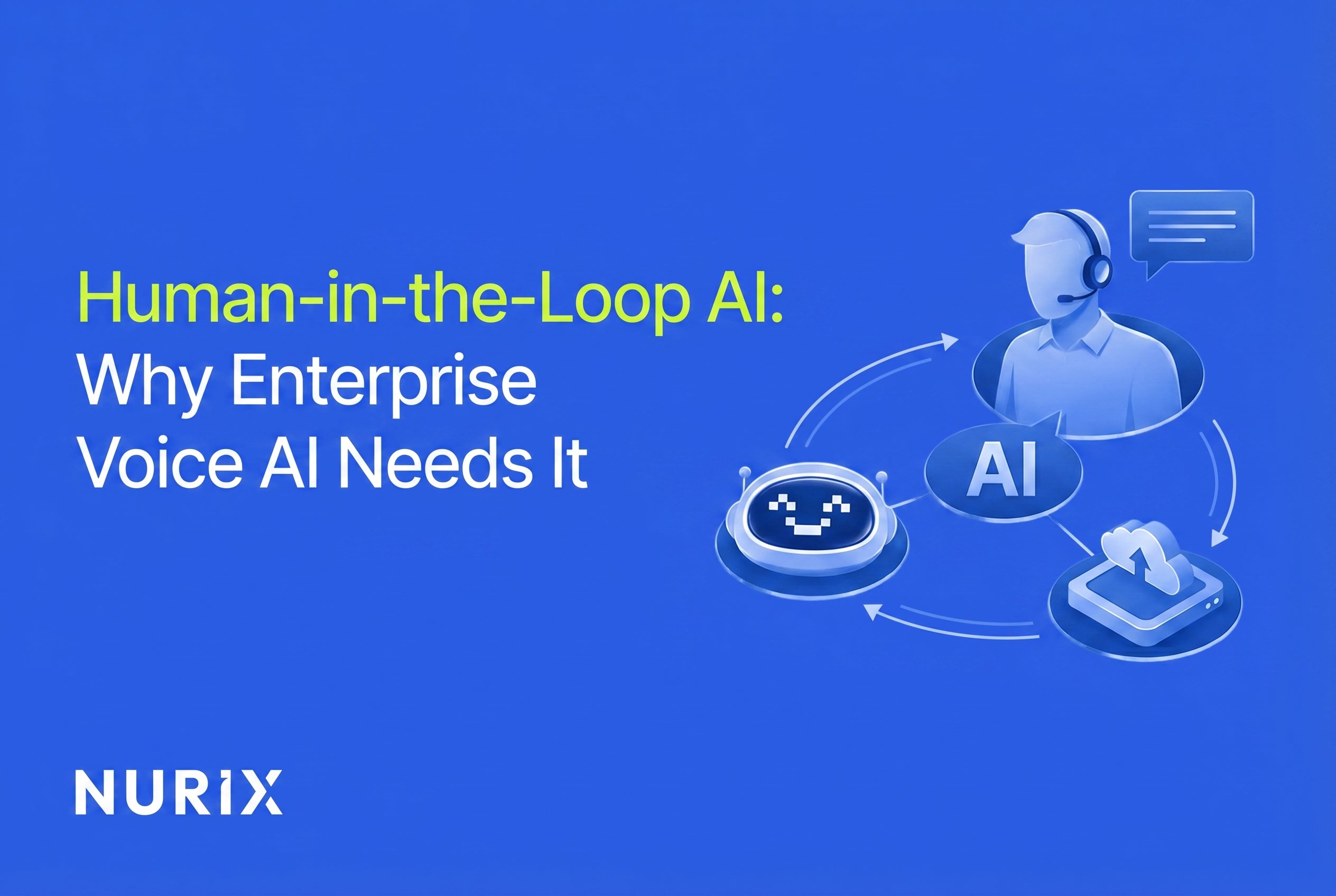

Human-in-the-Loop AI: Why Enterprise Voice AI Needs It
Enterprise AI has a trust problem. Hallucination rates in production LLMs still range from 3% to 27% depending on the domain. For voice AI handling live customer calls, where a single error can mean regulatory violations or lost revenue, those numbers are unacceptable.
Human-in-the-loop AI solves this by embedding human oversight directly into AI workflows. Automation handles the volume while people handle the judgment calls.
Most organizations understand why HITL matters. The harder question is how to architect it for enterprise-scale voice deployments, and when to dial human involvement up or down. That is what this guide addresses.
NuPlay (previously Nurix) is an enterprise AI platform for deploying conversational voice and chat agents at scale. Built with human-in-the-loop architecture at its core, NuPlay ensures that AI automation never operates in a vacuum.
For an introduction to human-in-the-loop voice AI, see our foundational guide that covers the core concepts and rationale. This article goes deeper: an advanced implementation guide that breaks down the specific design patterns, confidence calibration frameworks, and phased deployment strategies that enterprise teams need to operationalize HITL in production voice AI systems. For a deep technical walkthrough, watch Nex by Nurix Ep 36: Complete HITL Guide — a full episode dedicated to the design patterns and decision frameworks covered here.
Quick Verdict
Fully autonomous voice AI fails in enterprise environments where accuracy, compliance, and customer trust are non-negotiable. Human-in-the-loop AI is the architecture that makes production-grade voice AI possible — not a compromise on automation, but a requirement for it.
Organizations that implement HITL frameworks see:
- Up to 30% higher accuracy than autonomous-only deployments (Stanford HAI)
- Faster time to trust from stakeholders, regulators, and customers
- Measurably lower compliance risk through structured human oversight
If you are deploying AI agents that interact with customers, HITL is not optional.
What Human-in-the-Loop AI Actually Means in Practice
Human-in-the-loop (HITL) is not simply "having a person available if the AI fails." It is a deliberate system architecture where humans participate at defined points in the AI decision-making process — reviewing outputs, correcting errors, approving high-stakes actions, and continuously training the model through feedback loops. The "loop" is literal: human input feeds back into the AI, improving it over time.
In enterprise voice AI, HITL takes specific forms. A live agent monitors AI-handled calls and intervenes when confidence drops. A quality assurance team reviews flagged transcripts daily and corrects misclassifications. A compliance officer approves AI-generated responses for regulated disclosures before they enter production. Each of these is a HITL pattern, and each serves a different purpose in the system.
The distinction matters because many organizations claim to have HITL but actually have "human-on-the-side" — a person who could theoretically intervene but has no structured role in the workflow. True HITL means the human is architecturally embedded, with defined triggers, SLAs, and feedback mechanisms that close the loop back to the AI.
As Stanford HAI's 2024 AI Index documents, organizations with structured HITL processes achieve significantly better outcomes than those relying on ad-hoc human oversight.
Why Autonomous-Only AI Fails in Enterprise Voice Deployments
The case for full autonomy is compelling: lower costs, infinite scale, zero wait times. But enterprise reality punishes overconfidence.
McKinsey's 2024 survey of AI adoption found that only 11% of organizations have fully scaled AI solutions, and the primary barrier is not technology — it is trust. Executives, regulators, and customers simply do not trust AI to operate without guardrails in high-stakes scenarios.
The reasons are concrete. LLM hallucinations remain a persistent problem in production. Even the best-performing models produce confident but incorrect outputs at rates that are unacceptable for regulated industries.
In a voice AI context, a hallucinated policy detail, an incorrect account balance, or a fabricated product claim can trigger regulatory action. MIT research on AI-assisted work demonstrates that human-AI collaboration consistently outperforms either humans or AI working alone — the combination is the point.
Voice AI introduces additional failure modes that text-based systems do not face. Accent recognition errors, background noise misinterpretation, emotional tone misreading, and cross-talk in multi-party calls all degrade autonomous performance.
A customer saying "I did NOT authorize that charge" can be misheard as "I did authorize that charge" — a catastrophic error in financial services. No amount of model improvement eliminates these edge cases entirely. Human oversight catches what models miss, and the stakes in live voice interactions are simply too high for anything less.
Understanding the difference between AI agents and traditional chatbots makes it clear why orchestration with human oversight outperforms simple rule-based automation.
HITL Design Patterns for Enterprise AI
Effective human-in-the-loop systems are not ad hoc. They follow established design patterns that balance automation efficiency with human judgment. Three patterns dominate enterprise voice AI deployments.
Escalation Triggers
Escalation triggers define the specific conditions under which AI transfers control to a human. These are not vague rules like "escalate when the customer is upset." They are precise, measurable criteria:
- The customer explicitly requests a human agent.
- The conversation involves a complaint exceeding a defined dollar threshold.
- The AI detects regulatory language (HIPAA, PCI, GDPR keywords).
- The interaction has exceeded a maximum turn count without resolution.
Well-designed escalation triggers are exhaustive and hierarchical:
- Tier 1 — Routes to the next available agent for standard resolution.
- Tier 2 — Routes to specialized teams (compliance, retention, technical) for domain-specific issues.
- Tier 3 — Alerts management in real time for critical or high-liability situations.
Each tier carries its own SLA and context-passing requirements. The AI does not simply drop the call — it hands off a full transcript, customer profile, intent classification, and recommended next action.
Confidence Thresholds
Confidence thresholds are the numerical gates that determine whether the AI acts autonomously, asks for clarification, or routes to a human. A well-calibrated voice AI system operates in three zones:
- High confidence (above 0.90): Acts independently.
- Medium confidence (0.70-0.90): Proceeds but flags the interaction for review.
- Low confidence (below 0.70): Immediately involves a human.
These thresholds must be calibrated per use case. A balance inquiry can tolerate lower confidence because the downside of an error is minimal — the customer simply asks again. A payment authorization requires near-perfect confidence because errors have financial and legal consequences.
Gartner projects that by 2026, more than 80% of enterprises will have used generative AI, but only those with properly calibrated confidence systems will sustain production deployments.
Review Queues
Review queues are the asynchronous HITL pattern where AI-handled interactions are flagged for post-hoc human review. Not every interaction requires real-time intervention, but many require verification. Review queues let the AI handle volume at speed while humans verify quality at scale.
A mature review queue system prioritizes by risk: regulatory interactions are reviewed within hours, customer complaints within 24 hours, and routine interactions on a sampling basis.
The key insight is that review queues are not just quality assurance — they are training data pipelines. Every correction a reviewer makes feeds back into the model, systematically eliminating the error patterns that triggered the review in the first place.
Voice AI-Specific HITL: Where It Matters Most
Voice AI operates in real time, which makes HITL architecturally different from text-based systems. You cannot pause a phone call for 30 seconds while a reviewer checks an AI response. Voice HITL patterns must be instantaneous, invisible to the caller, and context-preserving.
Live Call Transfer
Live call transfer is the most visible HITL pattern in voice AI. When the AI determines it cannot resolve an interaction — or when the customer requests it — the call transfers to a human agent with zero dead air.
The critical differentiator is context passing. The human agent receives the full conversation transcript, the AI's intent classification, customer account data pulled during the conversation, and a suggested resolution path.
AI chatbots that pass full context during handoffs improve resolution rates by up to 35%, eliminating the "please repeat your issue" frustration that destroys customer trust.
NuPlay's NuPilot orchestration engine manages these transfers at the infrastructure level, routing calls based on agent skill, availability, customer segment, and issue complexity — not just the next available seat.
Agent Assist and Real-Time Coaching
Agent assist is the HITL pattern where the AI supports the human rather than replacing them. During a live call handled by a human agent, the AI listens in real time and provides contextual suggestions: relevant knowledge base articles, recommended responses, compliance reminders, and upsell opportunities. The agent decides what to use and what to ignore.
Real-time coaching takes this further. The AI monitors the agent's performance during the call — speech pace, sentiment trajectory, adherence to scripts — and provides live guidance through a dashboard or earpiece.
If the agent misses a required disclosure, the AI prompts it immediately rather than catching it in post-call review. NuPlay's NuPulse conversation intelligence platform powers this feedback loop, turning every call into a coaching opportunity that improves both AI and human performance simultaneously.
Supervisory Monitoring
Supervisory monitoring is the silent HITL pattern where managers observe AI-handled calls in real time through dashboards without intervening unless necessary. This pattern serves two purposes: it provides an immediate safety net for high-risk interactions, and it generates the qualitative insights that pure analytics cannot capture.
A supervisor hearing the AI struggle with a regional dialect or industry-specific jargon can trigger retraining faster than any automated metric.
HITL Design Patterns Compared
Implementation Framework: Building HITL into Your Voice AI Stack
Implementing human-in-the-loop AI is not a feature toggle. It requires deliberate architecture decisions across your entire voice AI stack.
Phase 1: Audit and classify interactions (Weeks 1-3). Analyze your call data to categorize every interaction type by complexity, risk, and automation suitability. Map each category to a HITL pattern: fully automated with review queue sampling, automated with confidence-based escalation, or human-primary with AI assist.
Most enterprises find that 60-70% of call volume falls into the first category, 20-25% into the second, and 5-15% into the third.
Phase 2: Define thresholds and triggers (Weeks 3-5). Set confidence thresholds for each interaction category. Define escalation triggers with specific, measurable criteria.
Establish SLAs for each HITL touchpoint: maximum seconds to live transfer, maximum hours to review queue resolution, and minimum sampling rates for quality assurance. Document these in a HITL policy that operations, compliance, and engineering all sign off on.
Phase 3: Build feedback loops (Weeks 5-8). Implement the data pipelines that close the loop. Every human correction, escalation outcome, and review queue annotation must flow back into the training pipeline.
Configure automated retraining schedules — weekly for high-volume use cases, monthly for stable ones. Build dashboards that track HITL metrics alongside AI performance metrics, because they are inseparable.
Phase 4: Deploy with progressive automation (Weeks 8-12). Start with higher human involvement than your target state. Run the AI in "shadow mode" where it processes every call but humans make final decisions.
Gradually reduce human touchpoints as confidence metrics prove the AI's reliability. This progressive approach builds organizational trust and generates the training data that makes full automation possible for appropriate use cases. Nex by Nurix Ep 36 walks through this phased deployment model in detail, including real implementation timelines from enterprise deployments.
Measuring HITL Effectiveness: The Metrics That Matter
HITL is only as good as your ability to measure it. Track these metrics to evaluate whether your human-in-the-loop architecture is working.
Escalation rate measures the percentage of AI-handled interactions that require human intervention. A healthy system sees this rate decline steadily over time as the AI learns from human corrections. If your escalation rate plateaus or increases, your feedback loops are broken. Industry benchmarks suggest mature voice AI deployments achieve escalation rates between 15-25%, depending on complexity.
Human correction rate tracks how often reviewers override or modify AI decisions. This is your most direct measure of AI accuracy in production. A declining correction rate means the model is learning. A flat rate means your retraining pipeline is not working. Segment this metric by interaction type to identify specific areas where the AI needs improvement.
Time to resolution should be measured separately for fully automated, human-assisted, and fully human interactions. The goal is not to minimize human involvement — it is to minimize resolution time. Sometimes adding a human touchpoint actually reduces total resolution time by preventing misrouted escalations or repeated interactions.
Feedback loop latency measures the time between a human correction and the AI incorporating that correction into its behavior. Best-in-class systems close this loop within 24-48 hours for critical patterns and weekly for general improvements. If your feedback loop takes months, your HITL architecture is providing quality assurance but not continuous improvement.
Customer satisfaction delta compares CSAT scores across HITL patterns. Track whether customers who experience a seamless AI-to-human transfer rate the interaction higher or lower than fully automated resolutions. Research consistently shows that customers prefer fast, accurate resolution regardless of whether a human or AI provides it — HITL ensures both speed and accuracy.
When to Reduce Human Involvement
HITL is not permanent scaffolding. It is a dynamic system where human involvement should decrease in areas where the AI has proven reliable and increase in areas where new risks emerge.
Reduce human oversight when:
- The AI's confidence scores consistently exceed thresholds for a specific interaction type over 90+ days.
- The human correction rate for that type drops below 2%.
- Customer satisfaction scores match or exceed human-only benchmarks.
At this point, move the interaction type from active HITL to review-queue-only monitoring. Continue sampling at 5-10% to catch regression.
Increase human oversight when:
- You deploy AI to new interaction types.
- Regulatory requirements change.
- Customer complaint patterns shift.
- You update the underlying model.
Any change to the system's inputs, outputs, or operating environment should trigger a temporary increase in human involvement until new baselines are established.
The most mature HITL architectures are self-adjusting. They use the AI's own confidence metrics and historical correction data to automatically modulate human involvement per interaction type.
NuPlay's AI agents are designed for exactly this: adaptive autonomy that scales human oversight up or down based on real-time performance data, not static rules. NuRep governs voice consistency and behavioral controls across these interactions, ensuring that as autonomy increases, brand compliance and response quality never degrade.