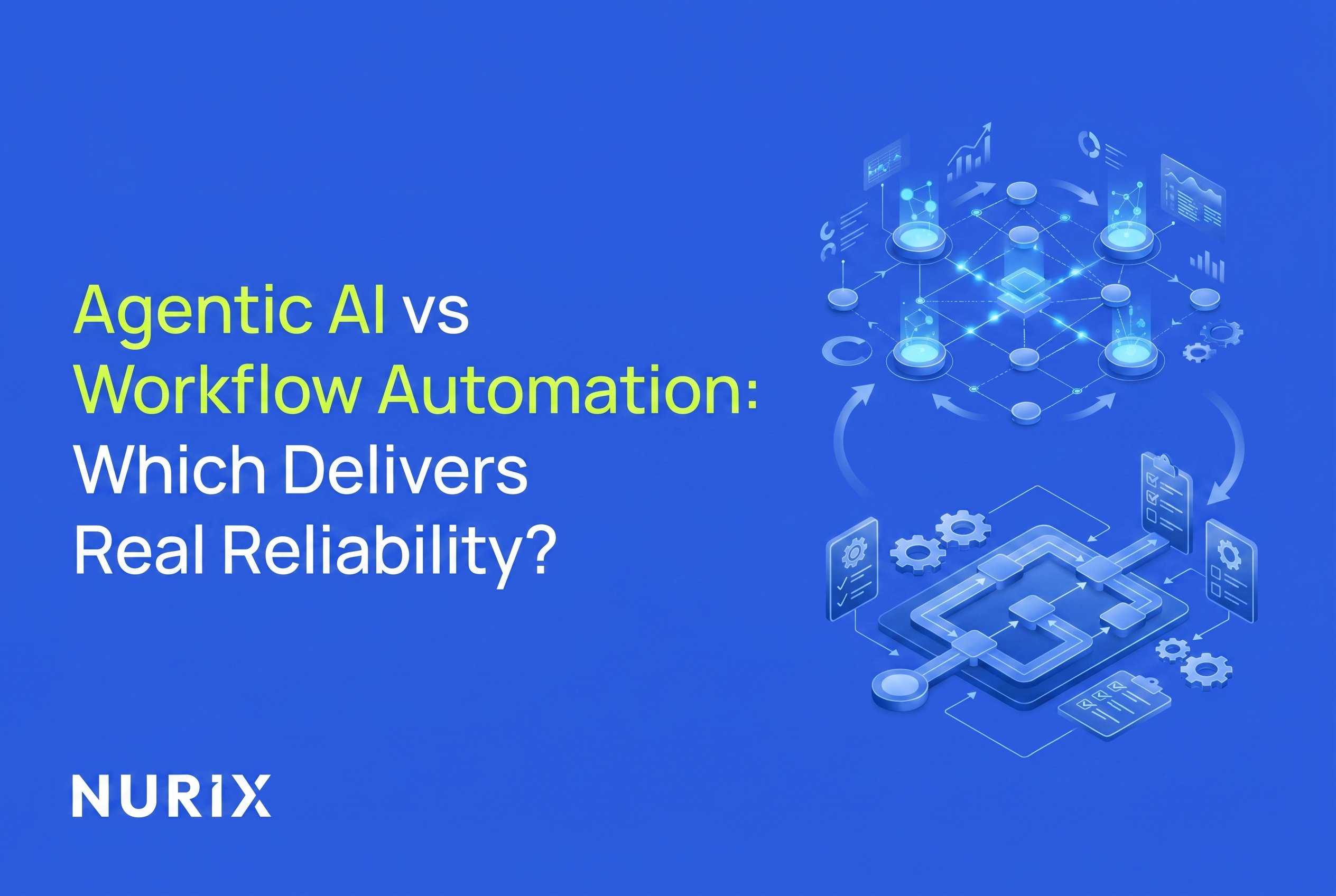

Agentic AI vs Workflow Automation: Which Delivers Real Reliability?
Enterprise teams have spent the last decade building workflow automation: deterministic, rule-based pipelines that move data from point A to point B without human intervention. It works. It scales. And for a wide range of business processes, it remains the right answer.
But a new paradigm is gaining ground. Agentic AI, autonomous systems that perceive, reason, and act, promises to handle the messy, ambiguous work that rigid workflows cannot.
Gartner predicts that by 2028, 33% of enterprise software applications will include agentic AI, up from less than 1% in 2024. McKinsey estimates that generative AI could automate 60-70% of employee workloads, with agentic architectures unlocking much of that potential.
The question facing engineering leaders is no longer whether to adopt AI, but where agentic systems genuinely outperform traditional automation, and where they introduce risk you cannot afford. This is exactly the debate we unpacked in Nex by Nurix Ep 32: Agents vs Workflows, and this article expands on the core arguments with a practical framework for enterprise decision-making.
At NuPlay (previously Nurix), we build enterprise AI agents that operate in production at scale. We have seen firsthand where agentic approaches deliver real reliability gains and where workflow automation remains the smarter bet. This piece is our honest assessment.
Quick Verdict
- This article focuses specifically on reliability, which approach you can trust in production when failure has real business consequences.
- For a broader look at the hybrid future of enterprise AI combining agents and workflows, see our companion analysis.
- There is no single winner.
- Workflow automation delivers unmatched reliability for deterministic, compliance-sensitive processes where every step must execute identically every time.
- Agentic AI delivers superior outcomes in dynamic, context-dependent scenarios where rigid rules break down under real-world complexity.
- The most effective enterprise architectures in 2026 combine both, using workflows as the backbone and deploying agentic AI at the points where adaptability creates measurable value.
What Is Agentic AI?
Agentic AI refers to AI systems that can autonomously perceive their environment, reason about goals, make decisions, and take actions, often across multiple steps, without explicit human instruction at each stage. Unlike a simple chatbot that responds to a single prompt, an agentic system maintains context, plans ahead, uses tools, and adjusts its approach based on outcomes.
The defining characteristics of agentic AI are:
- Goal-directed behavior: Works toward an objective instead of following a fixed script
- Tool use: Can call APIs, query databases, and interact with external systems
- Reasoning and planning: Breaks complex tasks into steps and sequences them
- Adaptive execution: Attempts alternative approaches when one fails
In an enterprise context, agentic AI shows up as customer service agents that resolve multi-step issues across systems, sales development agents that research prospects and personalize outreach, and operations agents that diagnose problems and execute remediation. These are not chatbots. They are autonomous AI agents with orchestration capabilities that go far beyond scripted conversation flows.
What Is Workflow Automation?
Workflow automation uses predefined rules, triggers, and sequences to execute business processes without human intervention. Think Zapier, n8n, UiPath, or custom orchestration pipelines. When event X occurs, execute steps A, B, and C in order. If condition Y is met, branch to step D.
Workflow automation is deterministic, producing the same outputs given the same inputs every time. It is transparent, letting you trace exactly which rule fired and why. And it is battle-tested. Enterprises have deployed workflow automation at scale for over a decade with well-understood failure modes.
The limitations become apparent when processes require judgment. A workflow can route a customer complaint to the right queue based on keywords, but it cannot understand the nuance of a frustrated VIP customer whose issue spans three departments and requires creative problem-solving. That gap is where agentic AI enters the picture.
Key Differences: Agentic AI vs Workflow Automation
Understanding the fundamental architectural differences helps enterprise teams make informed decisions about where each approach fits.
Decision-Making
Workflow automation makes decisions through branching logic, if-then-else trees defined at design time. Every possible path must be anticipated and coded in advance. This works beautifully for processes with a finite, well-understood set of conditions.
Agentic AI makes decisions through reasoning over context. The agent evaluates the current situation against its training, available information, and goal state to determine the best next action. This handles novel situations that no rule designer anticipated, but it introduces non-determinism. The same input might produce slightly different reasoning paths.
Adaptability
When a workflow encounters an input it was not designed for, it fails or falls back to a default path. Adding new capabilities means redesigning the workflow, testing the new branches, and redeploying.
Agentic systems adapt in real time. When an agent encounters an unexpected scenario, it can reason about available tools and information to find a path forward. Research on agentic architectures demonstrates substantially higher task completion rates on novel, multi-step tasks compared to rule-based systems, precisely because of this adaptive capacity.
Determinism and Predictability
This is where workflow automation holds a decisive advantage. Deterministic execution means you can predict, audit, and guarantee outcomes. For regulated industries like healthcare claims processing, financial transaction reconciliation, and pharmaceutical supply chain, predictability is not a feature. It is a requirement.
Agentic AI is probabilistic by nature. Even with guardrails, temperature controls, and structured output enforcement, there is inherent variability in how an LLM-powered agent reasons through a problem. This variability can be managed, and we will discuss how below. But it cannot be eliminated entirely.
Error Handling
Workflow automation handles errors through predefined exception paths. If step B fails, execute recovery path R. If the retry count exceeds three, escalate to a human. Every failure mode must be anticipated and handled explicitly.
Agentic AI can reason about errors dynamically. When an API call fails, the agent can try an alternative approach, gather additional context, or reformulate the request. This is powerful but also introduces a new category of risk. The agent might choose an error recovery path that is technically functional but operationally wrong.
Scalability and Maintenance
Workflow automation scales predictably but accumulates technical debt as processes grow more complex. A workflow with hundreds of branches becomes difficult to maintain, test, and modify. Industry research suggests enterprises spend a significant portion of their automation budget on maintaining and updating existing workflows rather than building new ones.
Agentic systems scale differently. Adding new capabilities often means giving the agent access to a new tool or updating its instructions, rather than redesigning an entire workflow. However, agentic systems require investment in observability, evaluation, and guardrails, infrastructure that is still maturing across the industry.
Agentic AI vs Workflow Automation: Head-to-Head
Here is a side-by-side comparison of agentic AI vs workflow automation across core enterprise dimensions:
Where Workflow Automation Still Wins
Let's be direct: there are categories of work where traditional automation is the correct choice, and deploying agentic AI would introduce unnecessary risk.
Regulatory compliance processes demand audit trails and deterministic outcomes. When a bank processes a Know Your Customer (KYC) check, every step must execute identically, produce documented evidence, and comply with specific regulatory requirements. An agentic system that "reasons" about compliance steps differently each time would be a liability, not an asset.
High-volume, low-variance transactions like invoice processing, payroll calculations, and inventory updates are workflows perfected over decades. The inputs are structured, the logic is well-defined, and the cost of an error is clear. Workflow automation handles these at massive scale with near-zero marginal cost.
System integration and data synchronization, such as moving data between CRM, ERP, and data warehouse systems, benefits from the reliability and predictability of traditional automation. When Salesforce needs to sync with NetSuite, you want a deterministic pipeline, not an agent deciding how to map fields.
Batch processing and ETL workloads are inherently sequential and deterministic. Workflow automation tools are purpose-built for these patterns and offer mature monitoring, retry logic, and error handling that agentic frameworks have not yet matched.
Where Agentic AI Wins
Equally, there are domains where workflow automation hits a ceiling and agentic approaches deliver measurably better outcomes.
Dynamic customer interactions are the clearest example. Real customer conversations are messy. They span topics, require context from multiple systems, involve emotional nuance, and rarely follow a script. NuPlay's AI agents handle exactly this kind of complexity, resolving multi-turn customer issues that would require dozens of workflow branches to approximate poorly.
Complex reasoning tasks that require synthesizing information from multiple sources, weighing tradeoffs, and generating novel solutions are natural territory for agentic AI. Analyzing a contract for risk, triaging an IT incident based on symptoms across multiple systems, or personalizing a financial recommendation based on a client's full portfolio all require flexible reasoning that rule-based systems cannot replicate.
Unstructured data processing at scale is another agentic strength. When inputs are emails, voice transcripts, images, or free-form text, the agent's ability to interpret meaning and extract structured information outperforms keyword matching and regex-based extraction.
Exception handling in customer operations often involves scenarios that are too rare to justify building dedicated workflow branches but too important to ignore. An agentic system can handle the long tail of edge cases that would otherwise require human escalation, driving down resolution times and operating costs.
The Hybrid Approach: Workflows as Backbone, Agents at the Edge
The most sophisticated enterprise architectures we see at NuPlay combine both paradigms. Our analysis of agents vs workflows and the hybrid future of enterprise AI explores this convergence in detail.
The pattern looks like this:
Workflow orchestration handles the process backbone. The overall business process (intake, routing, validation, execution, logging) follows a deterministic workflow. This provides the auditability, predictability, and operational control that enterprise teams need.
Agentic AI operates at decision points within the workflow. At specific steps where judgment, reasoning, or natural language understanding is needed, the workflow hands off to an agent. The agent processes the task and returns a structured result that the workflow continues to process deterministically.
This is the architectural philosophy behind NuPilot, NuPlay's orchestration layer. NuPilot lets enterprise teams define the deterministic process rails while deploying agentic capabilities at the points where they create value. The workflow guarantees the process completes correctly. The agent handles the parts that require intelligence.
For example, consider a customer refund process.
Workflow steps (deterministic):
- Validation: Is the order eligible for a refund?
- Approval routing: Does the refund amount exceed the threshold requiring manager sign-off?
- Financial execution: Process the refund through the payment system
- Notification: Send confirmation to the customer
Agentic system steps (intelligent intake):
- Interprets the customer's free-form request (email, chat, or voice)
- Identifies the correct order from account history
- Understands the reason for the return and categorizes it
- Determines urgency based on customer context and sentiment
Reliability Engineering for Agentic Systems
Deploying agentic AI in production requires a different reliability engineering approach than traditional automation. Here are the practices that separate production-grade agentic systems from demos.
Structured output enforcement constrains the agent's responses to well-defined schemas. Instead of accepting free-form text output, production agents return structured JSON that downstream systems can validate and process deterministically. This eliminates an entire category of failure modes.
Guardrails and boundary conditions define what the agent can and cannot do. Effective guardrails are not just prompt instructions. They are enforced programmatically through tool access controls, output validators, and policy layers. An agent that can reason about refund policies should not be able to modify database records directly.
Evaluation and monitoring must be continuous, not just pre-deployment. NuPlay's NuPulse conversation intelligence platform provides real-time visibility into agent performance, tracking task completion rates, reasoning quality, latency, and failure modes. Without this observability, agentic systems become black boxes that erode trust over time.
Human-in-the-loop escalation should be designed as a feature, not a fallback. The best agentic systems know when they are uncertain and escalate proactively. Confidence thresholds, anomaly detection, and explicit "I don't know" behaviors prevent the agent from confidently delivering wrong answers.
Regression testing with diverse scenarios catches behavioral drift that unit tests miss. Unlike deterministic workflows where you test specific branches, agentic systems need evaluation across a wide distribution of inputs, including adversarial cases and ambiguous scenarios.
As discussed in Nex by Nurix Ep 32, the reliability bar for enterprise agentic AI is not "works most of the time." It "fails gracefully every time." The episode goes deep on how production teams should think about failure modes, monitoring, and the cultural shift from debugging rules to evaluating reasoning.
Choosing the Right Approach for Your Use Case
Here is a practical decision framework for enterprise teams evaluating agentic AI vs workflow automation:
Choose workflow automation when:
- The process is well-defined with fewer than 20 meaningful decision branches
- Inputs are structured and predictable
- Regulatory requirements demand deterministic audit trails
- The error cost of creative problem-solving exceeds the error cost of rigid rule-following
- The process changes infrequently (quarterly or less)
Choose agentic AI when:
- The process involves natural language understanding or generation
- Inputs are unstructured or highly variable
- The task requires reasoning across multiple information sources
- The long tail of edge cases creates significant operational cost
- The process needs to adapt frequently to new scenarios without engineering cycles
Choose a hybrid approach when:
- The overall process is well-defined but contains specific steps that require judgment
- You need both auditability and adaptability
- The volume justifies the investment in both infrastructure types
- You want to incrementally introduce agentic capabilities without replacing existing automation
For most enterprise teams in 2026, the hybrid approach is the pragmatic starting point. It lets you capture the value of agentic AI without abandoning the operational discipline that workflow automation provides. Start with one high-impact decision point, deploy an agent there, measure the results, and expand.
The Bottom Line
The agentic AI vs workflow automation debate is not a technology horse race. It is a question of matching the right tool to the right problem.
Workflow automation excels at deterministic, high-volume processes where predictability is paramount. Agentic AI excels at dynamic, context-dependent tasks where rigid rules break down.
The enterprises that will lead in operational efficiency over the next three years are the ones building architectures that leverage both.
At NuPlay, we have built our platform around this conviction. NuPilot provides the orchestration backbone. NuPlay's AI agents handle the intelligent decision-making, with NuRep ensuring brand-consistent interactions. NuPulse delivers the conversation intelligence that makes agentic systems trustworthy in production. The result is not just automation, it is reliable intelligence at enterprise scale.
The right question is not "agentic AI or workflow automation?" It is "where in my operation does each approach deliver the most reliable outcomes?" Start there, and the architecture follows.