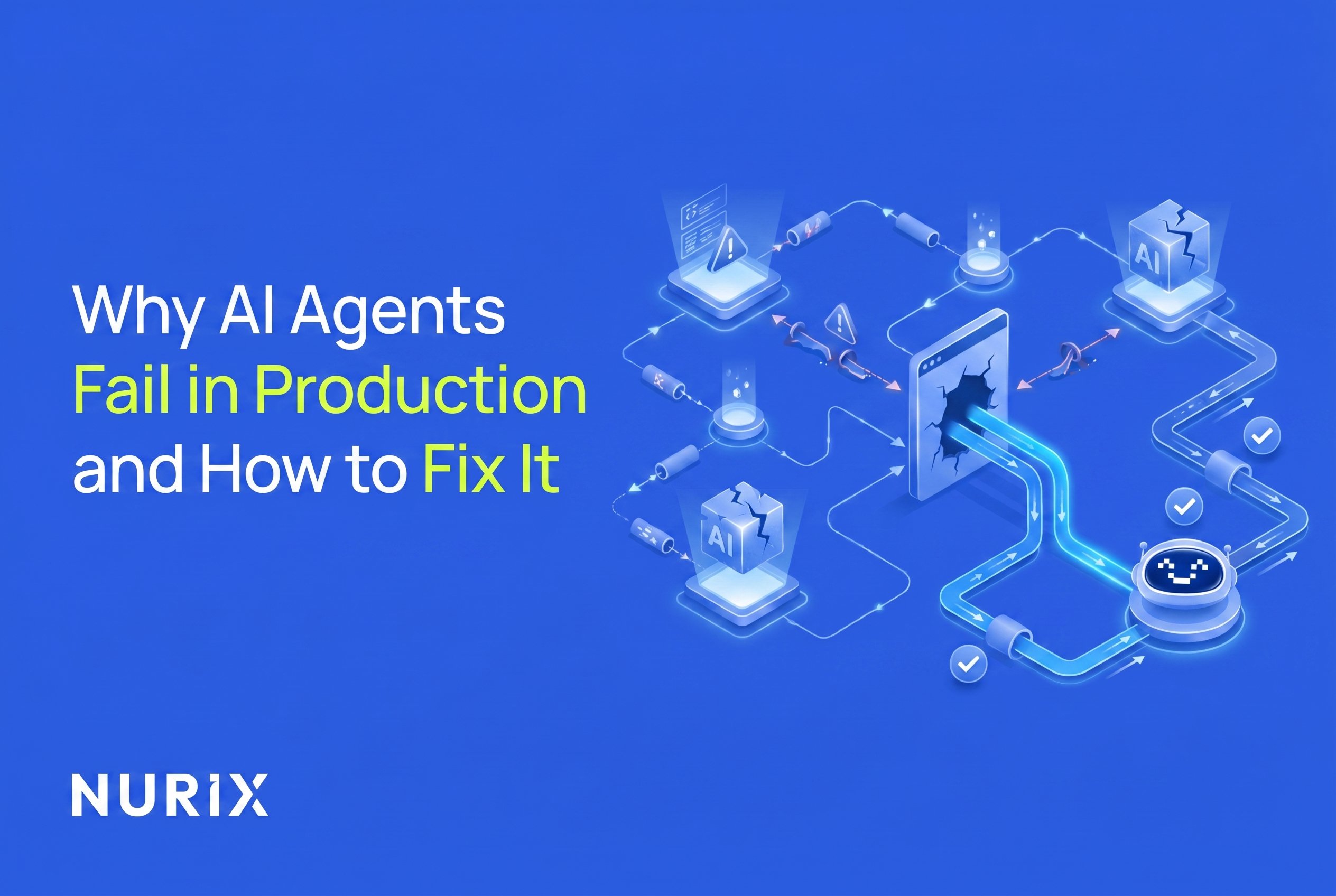

Why AI Agents Fail in Production (And How to Fix It)
Most AI agent projects never make it past the pilot stage. Enterprise teams invest months in development, celebrate promising demo results, then watch performance collapse when real users interact with the system at scale.
The gap between a working prototype and a production-grade AI agent is where billions of dollars in enterprise investment go to die.
Understanding why AI agents fail in production is the first step toward building systems that actually deliver sustained business value. This article is a diagnostic guide — a failure analysis framework that helps engineering teams identify root causes and build observability into every layer of the agent stack. For a solutions-focused perspective, see our companion guide on AI agent production solutions.
NuPlay (previously Nurix) has deployed conversational AI agents across enterprise environments where failure isn't an option. This article draws on real deployment patterns, industry data, and lessons from the Nex by Nurix podcast series to explain exactly where agents break down and how engineering leaders can fix each failure mode before it reaches customers.
Quick Verdict
AI agent failure in production is overwhelmingly a systems problem, not a model problem. The most common causes are:
- Poor integration design
- Missing fallback logic
- Insufficient monitoring
These are infrastructure gaps, not model capability gaps. Organizations that treat AI agent deployment as an infrastructure and orchestration challenge rather than a pure ML problem achieve 3-5x higher production success rates.
Building resilience into every layer of the agent stack — from prompt design through observability — separates the 15% of AI projects that succeed from the 85% that don't.
The Scale of AI Agent Failures: What the Data Says
The statistics on AI project failure rates are stark. Industry research consistently shows that the vast majority of AI projects fail to deliver on their intended promises — a figure that has barely improved despite exponential increases in model capability.
McKinsey's research found that while 72% of organizations have adopted AI in some form, only 10% have successfully scaled AI agents in any individual business function. The adoption curve is steep, but the production success curve remains painfully flat.
Production failure doesn't always mean a dramatic crash. More often, it looks like gradual degradation:
- Response accuracy drops from 95% in testing to 78% with real traffic
- Latency spikes during peak hours render the agent unusable
- Edge cases accumulate until human escalation rates exceed what the system was supposed to reduce
MIT Sloan Management Review has documented how organizational factors compound technical ones, turning promising pilots into expensive write-offs.
The financial impact is significant. Enterprise AI agent deployments typically cost between $500K and $2M. When these projects fail, organizations don't just lose the direct investment — they lose:
- The 6-12 months of organizational momentum
- The stakeholder trust required for future AI initiatives
- The competitive advantage that motivated the project
Top Reasons AI Agents Fail in Production
Production failures cluster around six recurring patterns. Each one is preventable, but only when engineering teams recognize and address them during the design phase rather than after deployment.
1. Hallucinations and Confidence Without Accuracy
Hallucinations remain the most visible and damaging failure mode for production AI agents. An agent that confidently tells a customer their refund has been processed when it hasn't — or quotes a policy that doesn't exist — erodes trust faster than any other type of error.
The problem intensifies in enterprise contexts where agents access proprietary data. Users reasonably expect that a system connected to their CRM should return accurate account information.
The root cause isn't model stupidity. It's the gap between what the model generates and what the enterprise knowledge base actually contains. Without proper grounding mechanisms, agents default to plausible-sounding responses drawn from training data rather than verified enterprise information.
In Ep 30 of the Nex by Nurix series, the team examined real production incidents where agents fabricated order numbers and tracking codes that followed the correct format but referenced nonexistent records. This demonstrates how hallucinations can be structurally correct yet factually wrong.
Real-world scenario: A customer contacts a retail AI agent asking about the status of order #RT-84291. The agent retrieves context about order status formatting but finds no matching record. Instead of acknowledging the gap, it generates a response: "Your order #RT-84291 shipped on March 15 and is expected to arrive by March 19." The order number format is correct, the dates are plausible — but the entire response is fabricated. The customer waits for a package that was never shipped.
Hallucination rates tend to spike in specific conditions:
- When queries fall outside the training distribution
- When the retrieval layer returns low-relevance context
- When the agent is asked to synthesize information across multiple disconnected knowledge sources
Production environments expose all three conditions far more frequently than controlled testing environments.
2. Poor Integration with Enterprise Systems
A demo agent that queries a single API endpoint looks impressive. A production agent that needs to read from Salesforce, write to ServiceNow, trigger workflows in an ERP system, and maintain transactional consistency across all three is an entirely different engineering challenge.
Integration brittleness is the second most common cause of production failure. It often manifests weeks or months after deployment when upstream systems change APIs, add authentication requirements, or modify data schemas.
The failure pattern is predictable. Teams build integrations against development environments with clean, consistent data. Production systems contain:
- Legacy data formats and null values in unexpected fields
- Rate limits that testing never triggered
- Timeout behaviors that differ from documentation
Each integration point becomes a potential single point of failure. Without proper orchestration architecture, one failed API call can cascade into a completely broken customer interaction.
NuPlay addresses this through NuPilot, its orchestration layer that manages integration state, handles retries with exponential backoff, and maintains conversation continuity even when individual backend systems experience transient failures. The difference between a fragile integration and a resilient one is entirely in the orchestration design.
3. No Fallback or Escalation Logic
Engineers optimizing for the happy path build agents that work brilliantly 80% of the time and fail catastrophically for the remaining 20%.
Missing fallback logic turns edge cases into customer-facing incidents. When an agent can't retrieve account information, can't understand the user's intent after multiple attempts, or encounters a scenario outside its trained capabilities, it needs a graceful exit strategy — not a confused loop or a generic error message.
The Nex by Nurix Ep 21 discussion highlighted how many enterprise pilots fail precisely at this point. The agent performs well during structured testing where inputs follow expected patterns. Then it encounters real customers who:
- Interrupt mid-sentence
- Change topics unexpectedly
- Provide incomplete information
- Express frustration in ways the system never trained on
Without explicit fallback paths for each failure mode, the agent either hallucinates an answer or enters an unrecoverable state.
Real-world scenario: A mortgage customer calls to check their loan application status but mid-conversation asks about changing the loan amount. The AI agent, trained only on status inquiries, attempts to answer the modification question using retrieval context about loan statuses. It returns a confidently worded but incorrect response about modification timelines. With proper fallback logic, the agent would have detected the out-of-scope intent and routed to a loan officer with full conversation context intact.
Effective fallback design requires mapping every possible failure point and defining explicit behavior for each:
- Model timeouts and low-confidence responses
- Out-of-scope requests and system outages
- User abandonment signals and frustration detection
The best production agents make fallback feel seamless: a warm handoff to a human agent with full context transfer, not a cold transfer that forces the customer to repeat everything.
4. Wrong Use Case Selection
Not every customer interaction should be automated by an AI agent.
Use case mismatch accounts for a large share of production failures that get mislabeled as technical problems. When organizations deploy agents for interactions that require deep empathy, complex negotiation, regulatory judgment, or genuine creativity, the agent doesn't fail because of a technical limitation — it fails because the use case was never suitable for automation in the first place.
The most successful deployments start with use cases that have:
- High volume
- Clear resolution criteria
- Structured data inputs
- Measurable outcomes
Good AI Automation Use Cases vs. Poor Ones:
Use cases with ambiguous resolution criteria, high emotional stakes, or regulatory sensitivity require human judgment that current AI agents can't reliably replicate.
Enterprises that audit their interaction logs before selecting use cases achieve significantly higher production success rates. The data reveals which interactions follow predictable patterns and which require the kind of contextual judgment that even the best agents struggle with at scale.
5. Insufficient or Low-Quality Training Data
Training data gaps create agents that perform well on common queries and fail on the long tail of real-world interactions. A training dataset built from internal QA testing or sanitized historical transcripts rarely captures the full variety of how customers actually express intent, reference products, and describe problems.
Quality matters as much as quantity. If 5% of training examples contain incorrect intent labels, the model learns a systematically skewed understanding that surface-level accuracy metrics won't catch.
Production data drift compounds this problem over time. Product launches, pricing changes, and seasonal patterns shift the distribution of customer queries away from what the training data represented.
6. Ignoring Edge Cases and Adversarial Inputs
Production environments are adversarial by default. Customers:
- Provide partial information
- Contradict themselves
- Test boundaries
- Sometimes actively try to manipulate the system
Edge case neglect during development creates agents that break under conditions that are uncommon individually but collectively represent 15-25% of production interactions.
The most dangerous edge cases don't trigger explicit errors. The agent proceeds confidently with an incorrect interpretation, takes action based on it, and the customer doesn't discover the error until later.
Multi-language inputs, ambiguous references, cross-department requests, and mid-sentence interruptions are each rare in isolation but collectively represent a significant failure surface. These silent failures are harder to detect, harder to debug, and more damaging to trust than visible crashes.
AI Agent Failure Modes: Diagnosis and Fix
How to Diagnose AI Agent Failure Points
Effective diagnosis requires instrumentation across four layers that go far beyond basic uptime monitoring.
Input quality monitoring captures the distribution of incoming queries and flags when production inputs diverge from training distributions. A sudden drop in average intent confidence signals that the agent is encountering queries it wasn't designed for — often the earliest indicator of a production problem.
Reasoning trace logging records the full chain of decisions the agent makes for every interaction:
- Which context was retrieved
- How it was ranked
- Why the model chose a particular response path
Without this trace, debugging production failures becomes guesswork.
Action execution tracking monitors every external action the agent takes — API calls, database writes, workflow triggers — with inputs, outputs, latency, and success status. This layer reveals integration failures and data consistency issues that impact resolution quality without triggering model-level errors.
Outcome validation measures whether the agent's actions actually resolved the customer's issue through post-interaction signals:
- Callback rates within 24 hours
- Ticket reopen rates
- Customer satisfaction scores
Outcome data closes the loop between what the agent thought it accomplished and what actually happened.
Fixing Each Failure Mode
Diagnosis without remediation is academic. Each failure pattern has specific engineering solutions. If you are looking for a broader walkthrough of production-ready fixes, our guide on why AI agents fail and how to solve it covers the solutions side in depth.
Eliminating Hallucinations Through Grounding
Hallucination prevention starts with retrieval-augmented generation (RAG) architecture that constrains output to verified enterprise data. Every factual claim should trace back to a specific document, database record, or knowledge base entry.
When the retrieval layer returns no relevant context, the agent should acknowledge the gap rather than generate a plausible guess.
Implement confidence thresholds that trigger different behaviors at different levels:
- High confidence — responses proceed normally
- Medium confidence — responses include hedging language and offer human verification
- Low confidence — routes directly to human agents with full context
NuPlay's AI agents use enterprise data grounding that validates every response against source records before delivery, cross-referencing CRM data and policy documents in real time.
Building Resilient Integrations
Replace point-to-point integrations with an orchestration layer that manages state, handles failures, and maintains conversation continuity. NuPilot's approach to agent orchestration demonstrates how production-grade systems decouple the conversation layer from backend integrations, so a Salesforce timeout doesn't crash the entire interaction.
Implement circuit breakers for every external dependency:
- When a backend system begins failing, the circuit breaker stops sending requests
- Returns a cached or default response
- Retries on a schedule
Version your integrations and maintain backward compatibility so that upstream API changes don't become production incidents for your AI agent.
Designing Comprehensive Fallback Paths
Build a failure mode taxonomy covering:
- Model failures — timeouts, low confidence, out-of-scope queries
- Integration failures — API errors, data inconsistency
- Conversation failures — misunderstanding, topic drift, user frustration
- Business logic failures — policy exceptions, authorization limits
For each mode, define the fallback behavior, escalation path, context transfer, and logging requirements.
The fallback should feel natural. A warm transfer like "Let me connect you with a specialist who can see everything we've discussed" preserves the relationship that a cold "transferring you now" undermines.
Test fallback paths as rigorously as happy paths through failure injection in your QA process.
Validating Use Case Fit Before Deployment
Create a use case scoring framework across five dimensions:
- Volume — Is there enough interaction volume to justify automation?
- Consistency — Do interactions follow predictable patterns?
- Data availability — Is structured data accessible for grounding?
- Risk tolerance — What is the cost of an incorrect response?
- Measurability — Can you define clear success metrics?
Interactions scoring high across all five are strong automation candidates. Low scores on any dimension signal the need for human-in-the-loop design rather than full automation.
Run shadow deployments before full production launches. The agent processes real interactions in parallel with humans, but responses are evaluated rather than delivered. This reveals production failure patterns without exposing customers to unvalidated performance.
Closing Training Data Gaps and Hardening Against Edge Cases
Implement a continuous data flywheel that:
- Captures production interactions
- Identifies failure patterns
- Generates new training examples
- Retrains models on a regular cadence
Prioritize high-value training data: interactions with low confidence, human escalations, and negative outcome metrics. A targeted dataset of 1,000 edge case examples often improves production performance more than 100,000 additional common-case examples.
Build an edge case library from production data, categorized by frequency, severity, and fix complexity. Use adversarial testing (red teaming) as a regular practice, not a one-time exercise. Prompt injection attempts, rapid topic switching, contradictory information, and extreme hostility all reveal vulnerabilities that standard testing misses.
Building Resilient AI Agents: An Architecture Checklist
Production resilience emerges from deliberate architectural decisions made before deployment, not patches applied after failure. The following principles separate agents that survive production from those that don't.
Layered validation means no single component is trusted entirely:
- The retrieval layer validates context relevance
- The generation layer validates factual accuracy against retrieved context
- The action layer validates that intended operations match business rules
- The output layer validates that responses meet quality and compliance standards
Each layer catches failures the previous one missed.
Stateful conversation management maintains full interaction context across turns, channels, and sessions. When a customer returns after being disconnected, the agent picks up exactly where the conversation left off.
Stateless designs force customers to repeat information and create inconsistent resolutions.
Graceful degradation by design means the architecture anticipates component failures and defines reduced-capability modes:
- If the knowledge base is unavailable, the agent handles simple account lookups
- If the CRM is down, the agent collects information and promises a callback
- No single component failure results in complete service outage
Human-in-the-loop circuits ensure agents can request human assistance without breaking the customer experience. The human receives full context, the conversation continues seamlessly, and the AI agent learns from how the human resolved the issue.
Monitoring and Observability for Production AI Agents
Traditional metrics like uptime and error rates capture infrastructure health but miss AI-specific performance nuances.
NuPulse, NuPlay's conversation intelligence platform, tracks not just whether the agent responded, but whether the response was accurate, relevant, and resulted in successful resolution. This distinction between operational and quality metrics is where most monitoring falls short.
Build dashboards around four metric categories:
- Operational metrics — latency, throughput, error rates, and availability
- Quality metrics — intent accuracy, hallucination rates, and response relevance
- Business metrics — resolution rates, escalation rates, CSAT, and cost per interaction
- Drift metrics — input distribution changes, confidence trends, and performance degradation over time
Set up automated alerting that triggers on quality degradation, not just infrastructure failures. A gradual decline in intent confidence scores over two weeks is a more actionable signal than a momentary latency spike.
If the proportion of low-confidence responses increases by more than 10% week over week, something has changed and requires investigation.
Conduct regular model audits against a curated test suite of production-representative interactions. Monthly audits catch gradual degradation that real-time monitoring might miss. Include adversarial examples and recently discovered failure patterns in every audit cycle, comparing current performance against deployment baselines to quantify drift.
Moving Forward: From Fragile Pilots to Production-Grade Agents
The difference between AI agents that fail in production and those that succeed is rarely about model capability. It's about engineering discipline:
- Proper integration architecture
- Comprehensive fallback design
- Continuous monitoring
- A culture that treats production failures as learning opportunities rather than embarrassments
Organizations ready to move beyond fragile pilots should start by auditing their current agent deployments against the failure modes outlined above. Identify which patterns are present, prioritize fixes based on customer impact, and implement observability that makes future failures visible before they reach customers.
The NuPlay platform was built specifically for enterprises that need production-grade AI agents with the resilience, observability, and orchestration that real-world deployments demand.
The 85% failure rate for AI projects isn't inevitable. It reflects the industry's current maturity, not an inherent limitation of the technology. Teams that apply the diagnostic and remediation frameworks covered here position their AI agent deployments among the 15% that deliver lasting enterprise value.