
How AI Voice Agents Are Fixing Enterprise Recruitment At Scale
The global recruitment industry is worth over $642 billion. A significant portion of that spend flows directly into processes that have not meaningfully changed in decades.
Screening calls. Interview scheduling. Follow-ups. ATS updates. Disposition emails. These tasks do not require judgment. They require time and they consume hours of recruiter bandwidth every single day, at every level of the enterprise.
This is not a resource problem. It is a design problem. And AI voice agents are solving it at the layer where the inefficiency actually lives.
The Volume Problem at the Top of the Funnel
Recruitment at enterprise scale is a volume game. A single posting can attract hundreds, sometimes thousands, of applications. No team can meaningfully engage all of them, so most don't. The top of the funnel becomes a black hole. Candidates apply, hear nothing, and move on.
The cost of that failure is rarely surfaced clearly. According to the 2025 HR Tech Report, businesses using AI recruitment software have seen a 35% reduction in cost per hire and organizations that haven't automated are absorbing that gap every single hire. At scale - across dozens of open roles, across multiple business units that number compounds into a material budget problem.
But cost is only part of it. When recruiters are buried in screening volume, they cannot spend time on the candidates who actually matter. The high-judgment work - relationship building, selling the role, reading a candidate's potential - gets crowded out by the administrative. The humans in the process are doing the work that should never have required a human at all.
What AI Voice Agents Actually Replace
AI voice agents in recruitment are not replacing recruiters. They are taking over the part of the process that should have been automated years ago: the initial screening call.
Consider what that call actually involves. A recruiter dials a candidate, asks three to five standard questions, takes notes, makes a disposition decision. Then does it again. Fifty times a week. There is no meaningful variation between calls. The questions are the same. The evaluation criteria are the same. The output - a pass, a hold, a decline - is the same.
That is not a high-judgment task. It is a repeatable workflow. And repeatable workflows are precisely where AI delivers measurable returns. AI-powered tools are cutting recruitment costs by up to 30% and reducing time-to-hire by an average of 50%. The technology is not experimental - it is already running in production across enterprises today.
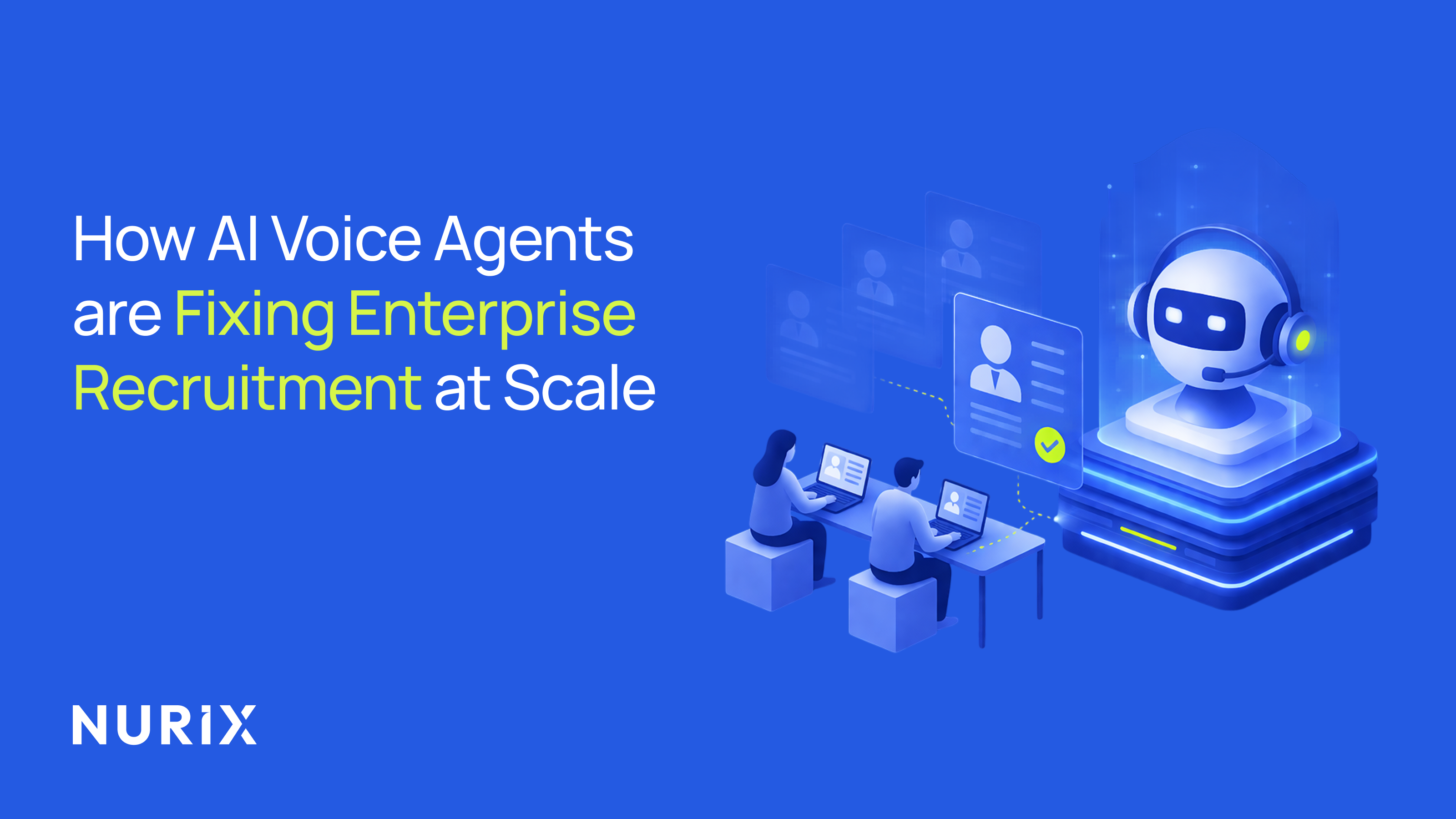
A well-designed voice AI agent conducts that screening call with natural conversation, evaluates answers against the intent behind what a strong response looks like — not just keyword matching and dispositions the candidate instantly. The full call packet, including transcript, recording, and summary, lands directly in the ATS. The recruiter opens their dashboard to a clean, ready-to-act shortlist. No bottlenecks. No batching. No delay.
And it runs at 3am on a Sunday just as accurately as 2pm on a Tuesday.
What This Looks Like in Practice
The proof is not theoretical.
Working with a large enterprise to deploy exactly this kind of solution, the brief was clear: screen candidates faster, without overwhelming the team, and without compromising candidate experience.
The workflow was built on consent and continuity. When a candidate is shortlisted, they receive an SMS notifying them and confirming that a screening call will follow once they reply. That reply is their opt-in - no cold calls, no surprises. The candidate authenticates through a portal, a webhook fires to NuPlay, and the outbound call is triggered automatically.
The AI voice agent asks three questions, designed by the client's own recruitment team, against criteria they defined. At the end, the candidate is marked Pass or In Review. Ambiguous cases route to a human. The goal was never to remove people from the process. It was to make sure the right people were spending time on the right decisions.
The result is a recruiter experience defined by leverage, not volume. High-value candidate conversations. Context they did not have to gather themselves. A funnel that keeps moving whether the team is online or not.
The Infrastructure Behind It
This kind of deployment requires more than a voice bot that can ask questions. It requires a platform built to handle the orchestration - the consent flow, the identity verification, the real-time ATS sync, the call logging, the escalation routing — reliably, at scale, across every interaction.
NuPlay is built for exactly that.
Deployments go live in days, not months. NuPlay connects with existing ATS, CRM, and telephony infrastructure without requiring rebuilds. Conversations are low-latency and natural - candidates consistently report that the interaction does not feel like a scripted IVR. Every call is transcribed, summarized, and returned to the system of record automatically. Teams report 20–40% lower cost-per-hire when AI automates screening and scheduling and NuPlay operates across inbound, outbound, and web-embedded channels, 24 hours a day.
The screening problem is one workflow. The platform is built for the full recruitment lifecycle and beyond it.
The Window Is Now
The enterprises moving fastest on AI-powered recruitment are not waiting for perfect. They are deploying, learning, and iterating in production. According to SHRM, the average cost per hire now sits at nearly $4,700 and that number only grows when manual processes slow down the funnel, push candidates to disengage, or force repeat cycles.
The gap between a team that has automated first-line screening and one that hasn't is not closing - it is widening.
The infrastructure to fix the top-of-funnel problem exists. The integrations are built. The compliance and consent architecture is solved. The only remaining question is how long the old model stays in place.
For most teams, the honest answer is: not much longer.