
AI Voice Agents That Plug Into Salesforce, HubSpot, and Zendesk in 2026
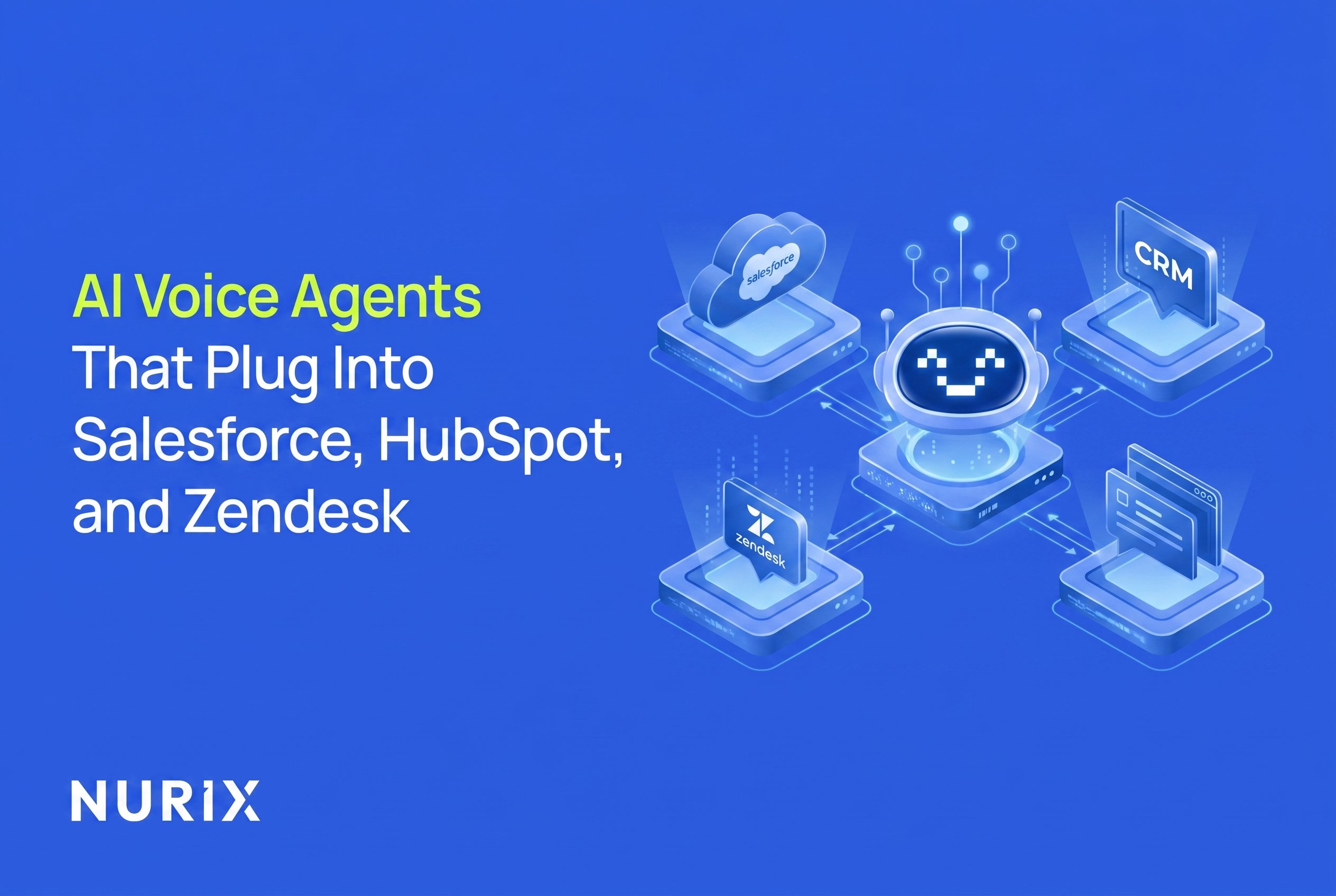
AI voice agents integrate with Salesforce, HubSpot, and Zendesk through application programming interface (API) connections that let the agent read customer records, update fields, create tickets, and route cases during live calls. In a Gartner survey of 321 customer service leaders, 91% reported executive pressure to implement AI in 2026, and CRM-connected voice agents are one of the highest-impact deployment patterns. This guide covers the workflows these integrations support, what to evaluate before deployment, and the security controls that matter.
For support and sales teams, this matters because the CRM is where customer history, pipeline status, tickets, and follow-up tasks already live. A voice agent that cannot read or write to those systems becomes another disconnected tool. A voice agent that is integrated into them can complete work while the customer is still on the call.
Platforms like NuPlay (previously Nurix) are built for that enterprise use case: voice, chat, and workflow agents that operate across existing systems rather than sitting outside them.
What Are CRM-Connected AI Voice Agents?
CRM-connected AI voice agents are AI agents that handle live voice interactions while reading from and writing to enterprise systems such as Salesforce, HubSpot, and Zendesk. They combine speech recognition, dialogue management, AI workflow automation, and secure integrations so conversations trigger real business actions. According to Salesforce's Seventh Edition State of Service report, based on 6,500 service professionals, AI is expected to resolve 50% of all service cases by 2027, up from 30% in 2025, and CRM-connected agents are a core enabler of that shift.
In practice, that means a caller can ask about an account, a support ticket, a renewal, or a meeting request, and the agent can use approved workflows to retrieve context, update fields, create tasks, or route the case to the right team.
Why Salesforce, HubSpot, and Zendesk Integrations Matter
Salesforce, HubSpot, and Zendesk often sit at the center of enterprise customer operations. Salesforce may hold account and opportunity data. HubSpot may manage inbound leads, lifecycle stages, and marketing context. Zendesk may hold support tickets, service-level agreements, and escalation history.
If a voice agent is not connected to those systems, it can only answer generic questions or collect information for someone else to process later. That creates delays and duplicate work.
With native or well-governed API integrations, the agent can work inside the operating system of the business. It can check an account, log a call, update a ticket, qualify a lead, or create a follow-up task without forcing a human agent to re-enter the same information.
Common Workflows for Integrated AI Voice Agents
Here is a side-by-side comparison of the CRM and helpdesk workflows that integrated voice agents can support.
SystemCommon Voice Agent WorkflowBusiness OutcomeSalesforceLead qualification, account lookup, opportunity updates, sales handoffFaster response to qualified prospectsHubSpotInbound lead capture, meeting scheduling, lifecycle-stage updatesCleaner marketing-to-sales routingZendeskTicket creation, status checks, escalation routing, customer context captureFaster support resolution and better handoffs
The strongest use cases are narrow, repeatable, and tied to clear system actions. Examples include checking order status, qualifying inbound leads, creating a support ticket, routing a billing question, or scheduling a sales call.
What Enterprise Buyers Should Evaluate
Enterprise teams should evaluate integrated voice agents on reliability, governance, and operating fit, not only voice quality.
First, check whether the platform supports secure, role-aware access to CRM and helpdesk data. The agent should only read and write what it is allowed to touch. Sensitive fields, regulated data, and account-level permissions need clear controls.
Second, evaluate how the platform handles action validation. Updating a CRM field is different from answering a question. The system should confirm intent, apply business rules, and avoid writing uncertain information into records.
Third, test handoff quality. When the voice agent escalates to a human, it should pass call context, intent, sentiment, account data, and attempted resolution steps. The Zendesk CX Trends 2026 report, based on more than 11,000 respondents, found that 74% of consumers are frustrated when they have to repeat information to different agents, and 81% want conversations to continue without backtracking. A poor handoff erases much of the value of automation.
How NuPlay Fits This Workflow
NuPlay is an enterprise AI platform for deploying conversational voice and chat agents at scale. For CRM-connected workflows, NuPlay is designed to connect conversation intelligence with business actions across sales, support, and internal operations.
Sales Voice AI Agents can help teams qualify leads, capture intent, schedule meetings, and route prospects into the right CRM workflow. Support Voice AI Agents can help teams handle account questions, ticket updates, returns, billing requests, and escalation triage.
NuPlay also includes platform layers that matter for enterprise deployments. NuPulse captures conversation intelligence and performance signals. NuRep supports brand voice and behavior governance so agents represent the company consistently across calls and channels.
Security, Compliance, and Data Controls
CRM-connected voice agents need strong controls because they operate close to sensitive customer records. Enterprises should ask how the platform authenticates users, protects call data, logs actions, and limits access to CRM and helpdesk fields.
NuPlay maintains SOC 2 Type 2 and ISO 27001 certifications and supports HIPAA and GDPR compliance requirements. For teams operating under TCPA or India's DPDP Act, the platform's consent handling and call recording controls should be evaluated against specific regulatory obligations.
For regulated teams, the review should include audit logs, human handoff rules, data retention, consent handling, and escalation paths. The agent should improve speed without weakening governance.
Operational Benefits
Integrated AI voice agents can improve enterprise operations in several ways.
- Cleaner data capture: The agent can write structured call notes, lead details, and ticket context directly into the right system.
- Faster routing: Qualified leads and urgent support cases can move to the right queue sooner.
- Lower repeat work: Human agents do not need to retype information the customer already gave.
- Better visibility: Sales and support leaders can review voice-agent activity inside the systems they already use.
- More consistent service: Approved workflows reduce variation across high-volume interactions.
The result is not automation for its own sake. The result is customer work completed inside the enterprise stack with more speed and control.
Conclusion
AI voice agents that plug into Salesforce, HubSpot, and Zendesk can turn customer conversations into completed sales and support workflows. The strongest deployments connect voice interactions to trusted systems, validate actions before writing data, and hand off complex cases with context.
NuPlay is built for that enterprise operating model. It helps teams deploy voice and chat agents that connect to existing systems, follow approved workflows, and improve customer operations without adding another disconnected tool. To evaluate the fit for your CRM or helpdesk environment, request a NuPlay walkthrough.