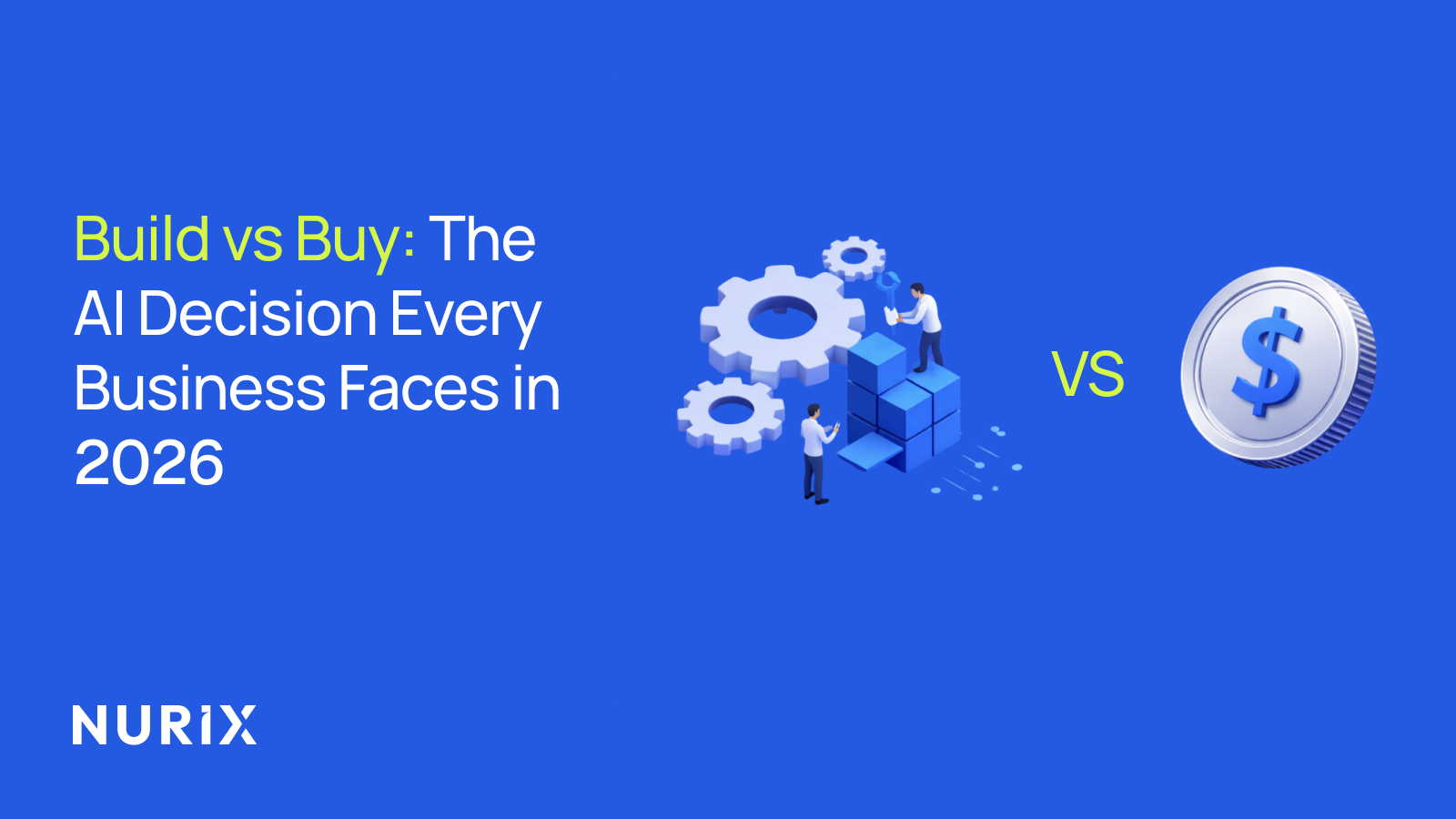

Build vs Buy: The AI Decision Every Business Faces in 2026
Enterprise AI investment is accelerating at a pace most organizations were not prepared for.
According to Anthropic's Economic Index, 36 percent of occupations already use AI in at least a quarter of their tasks. Enterprise AI spending jumped from $11.5 billion in 2024 to $37 billion in 2025. The question is no longer whether to adopt AI. It is how.
And almost every time that question surfaces inside a leadership team, one answer comes back faster than the others.
"Why don't we just build it?"
It sounds like the responsible choice. You protect IP. You maintain control. You avoid vendor dependency. But for most enterprises, it turns out to be the most expensive project they take on — not because the ambition is wrong, but because the full cost of that commitment is almost never honestly calculated before the decision is made.
What Building Actually Requires
There is a significant gap between what enterprise teams imagine when they say "build" and what building an agentic AI system at production scale actually demands.
You are not writing a few API calls and shipping a product. You are assembling a system that reasons across multiple steps, maintains context throughout a complete workflow, makes decisions at every node, and knows when to escalate to a human — and, critically, when not to.
You are building orchestration logic that connects your agent to your actual systems of record. You are solving for failure modes that only surface under production load, with real users, in live workflows. And unlike a passive tool, agentic systems carry real operational risk. When an agent takes an action and gets it wrong, the consequences are not contained to a log file. They are financial, operational, and reputational.
Which means you are also building the guardrails. The audit trails. The rollback mechanisms. The human-in-the-loop triggers.
That is not a feature. It is an entire platform — one that requires a permanent team to build, maintain, and continuously improve.
The Cost Nobody Models
When enterprises decide to build, they almost universally scope the cost of version one. The MVP that passes an internal demo and earns executive approval.
What they do not model is everything that follows.
Software is a long-term commitment. You own the bugs, the security patches, and the compatibility failures when a dependency breaks. You own the engineering capacity required to keep the system running in production while the rest of the roadmap waits.
For agentic AI specifically, this compounds quickly. The models these systems are built on are not static. What you built against one model generation can require significant rework when the next one ships. In this space, that happens in weeks.
Gartner has predicted that over 40 percent of agentic AI projects will be abandoned by 2027 due to costs spiraling out of control and insufficient risk controls. The projects failing are not the work of incapable teams. They are the result of commitments that were made without accounting for what production-grade, production-sustained AI infrastructure actually costs to own.
The Execution Gap
The MIT Gen AI study found that 95 percent of enterprise AI pilots fail to deliver measurable ROI.
The reason is almost never the pilot itself. Proof of concepts work. Demos run well. The gap emerges in the distance between a working demo and a system that is reliable, scalable, and genuinely changing how the business operates.
Internal builds succeed roughly 33 percent of the time. Enterprises that partnered with specialized vendors succeeded at roughly 67 percent — double the rate.
The pattern is consistent. Getting 75 percent of the way there is achievable for most teams. You build the proof of concept, connect the data, get it running. But that final stretch — from working in a controlled environment to reliable under real conditions at scale — is where internal teams hit the wall for the first time. A specialist partner has hit that wall across dozens of deployments. They have already solved it.
The Cost That Never Appears in the Spreadsheet
Beyond the direct financial calculation, there is a competitive cost that almost never shows up in build-versus-buy analysis.
Twelve to eighteen months. That is the typical timeline from decision to production for an internal enterprise AI build. A purpose-built vendor partnership moves the same journey to weeks. In a market where competitors are deploying and iterating quickly, that gap does not stay neutral.
Engineering focus. Every sprint directed at AI infrastructure is a sprint not spent on the core product. The opportunity cost of redirected engineering capacity compounds over time and is difficult to reverse.
Institutional fragility. When key AI engineers leave — and in the current talent market, they do — the team that remains inherits systems they did not design, under operational pressure they did not anticipate.
The Legitimate Case for Buying Carefully
Vendor lock-in is a real concern. Capability ceilings exist. Data security and compliance requirements do not disappear because you chose an external partner.
These are not arguments against buying. They are arguments for buying with precision — selecting a partner that treats compliance and security as architectural decisions rather than add-ons, and that gives you real portability as your requirements grow.
The question is not build or buy in the abstract. The question is: what does it actually cost to build this well, and is this where your competitive advantage lives?
For most enterprises, the honest answer is no. The competitive advantage lives in the workflows, the customer relationships, and the product. Not in the AI infrastructure underneath it.
How NuPlay Addresses This
NuPlay is Nurix's voice AI platform for enterprises that want to see what a production-ready, purpose-built agentic system looks like before committing to anything.
It is not a sandbox. It is a live, configurable platform where enterprises can run agentic voice workflows against real use cases — inbound support, outbound sales, collections, internal operations — across voice, chat, and messaging channels.
Built to Deploy, Not Just Demo
NuPlay is model-agnostic by design, automatically selecting the right model for each task based on accuracy, latency, and cost. Enterprises go live quickly and can update or upgrade models as the landscape evolves — without rebuilding agents from scratch.
Security as Architecture
Compliance controls, access management, data handling policies, and audit infrastructure are built into NuPlay from day one. Not added later.
The Hard Problems Are Already Solved
Orchestration complexity, production-grade reliability, cross-channel context continuity, deep CRM and ERP integration — these are the problems that consume most of an internal build timeline. With NuPlay, they are already solved.
Where the Decision Actually Lives
The build-versus-buy conversation is not going away. But the framing is sharpening.
The enterprises moving fastest are not the ones who built everything themselves. They are the ones who identified what is genuinely their competitive advantage, and what they were burning runway to reinvent.
AI infrastructure, for most organizations, falls firmly in the second category. The earlier that distinction is made clearly, the faster — and cheaper — the path to production becomes.
Most teams can build an AI agent. Very few can build, sustain, and scale the infrastructure underneath it. That is the decision.